


How to read a peptide sequence
Learn 20 letters and which end comes first, and MEHFPGP reads like a word.
Everything on this site is supplied strictly for in-vitro laboratory research. Not for human or veterinary use.
See our Research Use Only policy (opens in a new tab)For research use only


Research areas
Strictly for in-vitro laboratory research. Not for human or veterinary use.
Short chains of amino acids, built in a lab one link at a time. Here is what that means, in plain words.
The short answer
A research peptide is a short chain of amino acids, made in a lab by chemistry. It comes as a dry powder in a sealed vial or as a solution in a pen, for laboratory experiments only. It is not a medicine, a supplement or a cosmetic.
Every peptide is built from the same kind of building block, the amino acid, and life uses 20 common kinds.1 Each has a name and a short code; glycine, for example, is Gly, or just G.
Picture each amino acid as a bead. Join a few in a row and the chain you get is a peptide.
The link between two beads is a peptide bond. Each time two amino acids join they give off one small molecule of water,1 which is why textbooks call it a dehydration reaction.1
Order matters as much as the beads themselves. The order is called the sequence, and it is what makes one peptide different from another.1 Swap two beads and you have a new molecule.
A sequence is written as a row of codes, read from one end of the chain to the other. The chain in the drawing reads Gly-Ala-Ser-Lys, and GHK means glycine, then histidine, then lysine.2
Peptides and proteins use the same 20 kinds of bead. The difference lies in the length of the chain and in what the chain does next.
A short chain is a peptide, while a long chain that folds up into its own set shape is a protein.1 There is no single cut-off point, and textbooks draw the line in slightly different places.
The research peptides in our catalogue sit at the short end: GHK-Cu has 3 amino acids2 and MOTS-c has 16.3 One chain of collagen, a long structural protein, has 1,057 once it is finished.4
That shortness matters, because a short chain can be built by chemistry, one bead at a time.
Research peptides are usually not extracted from plants or animals. Most are built in a lab, by a method called solid-phase synthesis.
The chemist Bruce Merrifield published the method in 1963,5 and it won him the 1984 Nobel Prize in Chemistry.6 One amino acid is anchored to a resin bead, a small solid grain of plastic,6 and more amino acids are added to it one per round, in a set order.
After each round the leftovers are rinsed off, while the chain stays put because it is attached to the resin.6 Once the last amino acid is on, the finished chain is cut free.
Today, machines run these rounds automatically,6 and most peptides are made this way.7
No step is perfect. Now and then a round misses and a chain comes out one bead short, and near-copies like this are among the impurities a lab looks for.7 That is why the raw product is purified first.
Then it is freeze-dried, also called lyophilised: the solution is frozen and the ice is pulled off as vapour under a vacuum. A dry solid generally keeps better than the same compound sitting in water,8 so most research peptides travel as a powder.
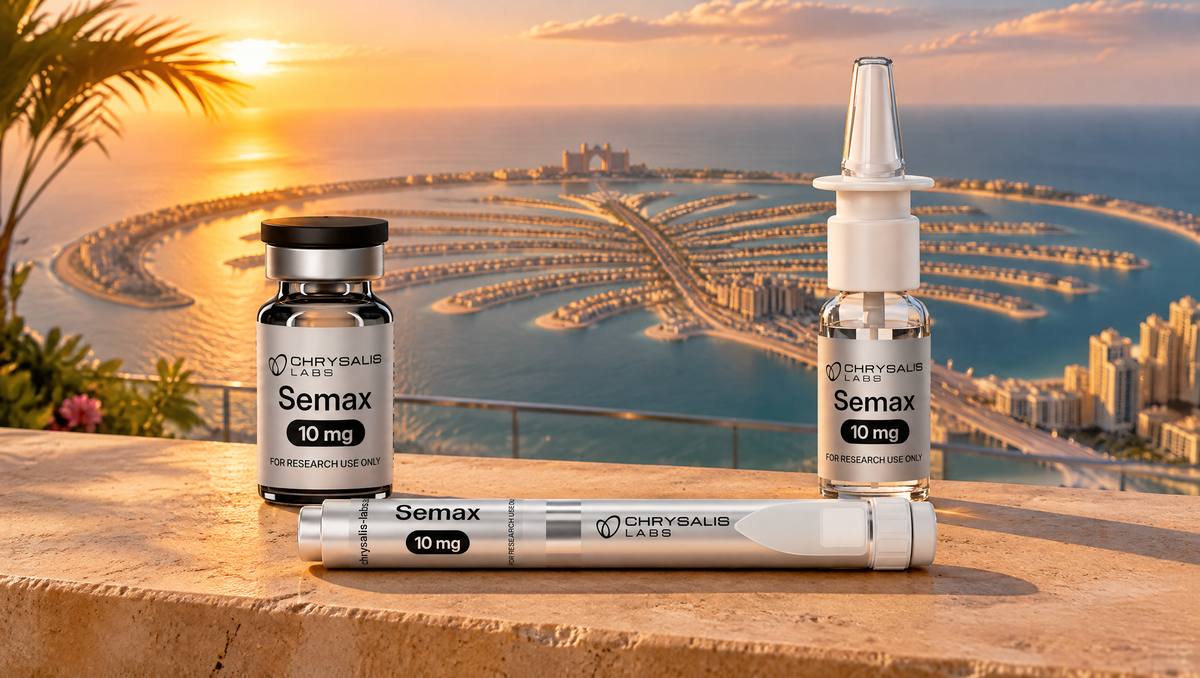
We stock research peptides in two formats.
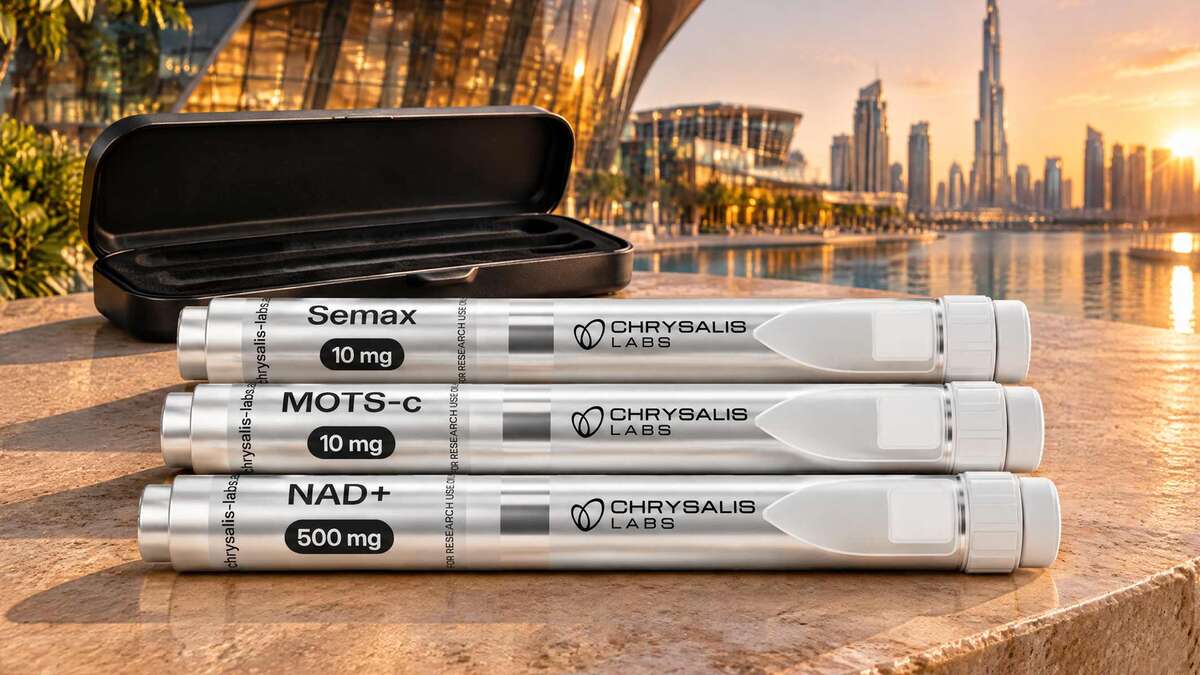
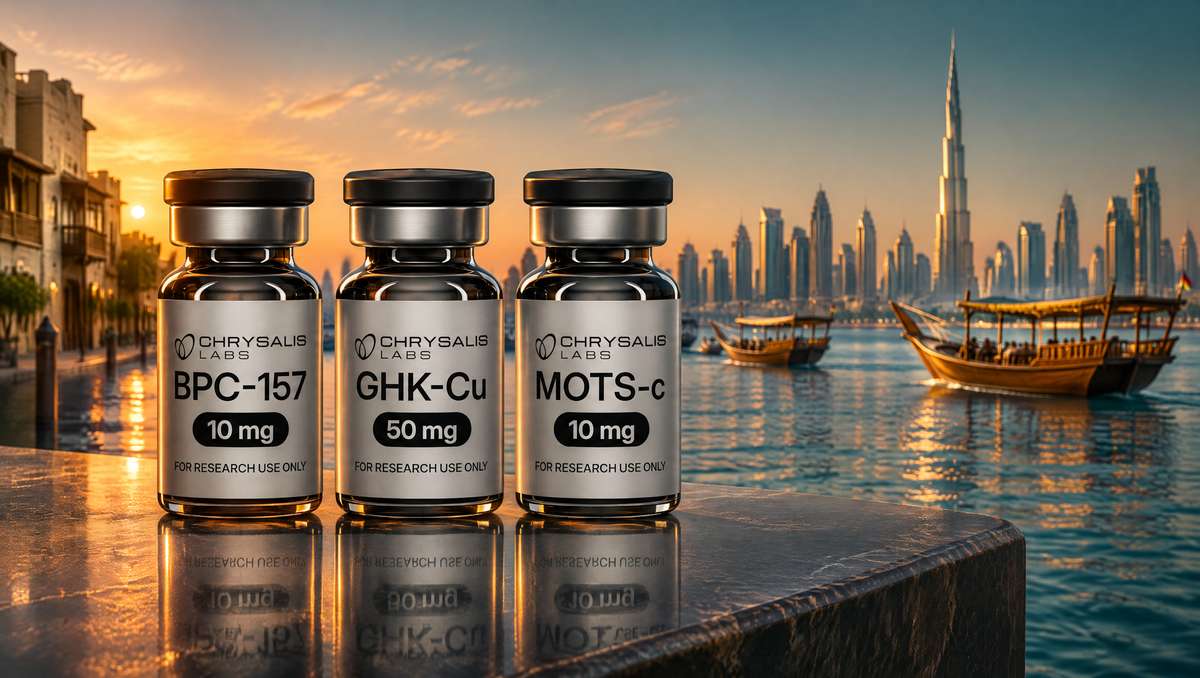
Freeze-dried powder, sealed in glass. Most of these powders are white; GHK-Cu is blue because of its copper.
Browse vialsA pre-filled pen holds the compound already dissolved, sealed inside. Pens are kept in the fridge, at 2–8 °C.
Browse pensEach product page names the format and the amount in one unit. Our MOTS-c 10 mg vial, for example, is labelled 10 milligrams of MOTS-c, as freeze-dried powder. The GHK-Cu 50 mg vial is labelled 50 milligrams of GHK-Cu.
The word "peptide" turns up on supplement tubs, in face creams and in pharmacies, and these are very different kinds of product.
Collagen, a large protein from cow, pig or fish, broken into small pieces with enzymes. The result is a mix of many different fragments, used as an ingredient in foods and other products.9
Small peptides listed as ingredients in creams, sometimes with a fatty tail added. One example from ingredient lists is palmitoyl pentapeptide-4: five amino acids plus a fatty-acid tail.10
Made for people, under strict health rules. A health authority must license each one before it can be sold.
One exact sequence, made by chemistry and sold for in-vitro lab work only. Not a food, a cosmetic or a medicine.
A research peptide sits in its own lane as a lab chemical: one defined molecule, labelled for experiments and not for people.
You will see the same line across our site and on this page: Strictly for in-vitro laboratory research. Not for human or veterinary use. Each part of it means something.
in vitro“in glass”
Not for
In vitro is Latin for "in glass". It means experiments in test tubes, dishes and plates, not inside a living body.
Laboratory research means the product is made for experiments, and for nothing else.
Not for human or veterinary use means exactly that: not for people, and not for animals. It is also why our guides never cover dosing, preparation or effects.
Read our Research Use Only policy · What "research use only" means
"Research grade" should mean something you can check on paper, and that paper is the certificate of analysis, or COA, the lab report for one batch. Three questions matter most.
1Identity
Is it the molecule on the label? Mass spectrometry weighs the molecules and looks for the expected mass.
2Purity
How much of it is that molecule? HPLC splits the sample into its parts. Small peaks are other things.
3Content
How much is in the vial? The amount measured, against the amount on the label.
Identity and purity are separate questions. A sample can be almost entirely one compound and still be the wrong one, so a good report answers both.
Content needs a closer look too. Besides the peptide, a freeze-dried powder can hold salts left over from the making, such as trifluoroacetate,7 which is why some reports give the net peptide content as its own number.
Purity and identity: two different questions · How to read a certificate of analysis
A research label is short on purpose. Read it in this order.
Close names really can mislead: GHK-Cu and AHK-Cu differ by just one amino acid.
You may also see a batch (lot) number or a storage line. The batch number ties a vial to the lab report for that batch. If anything on a label is unclear or doesn't match the product page, ask the supplier.
Strictly for in-vitro laboratory research. Not for human or veterinary use.
A short chain of amino acids, made in a lab by chemistry and sold for in-vitro laboratory research only. It is not a medicine, a supplement or a cosmetic.
Mostly length. A peptide is a short chain of amino acids, while a protein is a long chain that folds into its own set shape. There is no single cut-off point.
No. Collagen peptides are a mix of many fragments cut from animal collagen, used as a food ingredient. A research peptide is one exact sequence, made by chemistry for lab work.
In a lab, by a method called solid-phase synthesis. The chain grows on a resin bead, gaining one amino acid per round. At the end it is released, cleaned up and freeze-dried.
Because they are freeze-dried. The water is taken out, and a dry solid generally keeps better than the same compound in water.
The product is for in-vitro laboratory research: experiments in test tubes, dishes and plates. It is not for human or veterinary use.
Vials and pens, delivered across all seven emirates. Cash on delivery available.
Strictly for in-vitro laboratory research. Not for human or veterinary use.
Chrysalis Labs Research Team · Published
Learn 20 letters and which end comes first, and MEHFPGP reads like a word.
Four parts, one sealed solution, and a number on the label that tells you less than it seems to.
Same molecule, same 10 mg on the label, three containers. One of them goes straight into the fridge, and one is the only format you can’t pay for at the door.