

Peptide basics
How to read a peptide sequence
Learn 20 letters and which end comes first, and MEHFPGP reads like a word.
Everything on this site is supplied strictly for in-vitro laboratory research. Not for human or veterinary use.
See our Research Use Only policy (opens in a new tab)For research use only


Research areas
Strictly for in-vitro laboratory research. Not for human or veterinary use.
Research peptides in plain words.
Learn 20 letters and which end comes first, and MEHFPGP reads like a word.
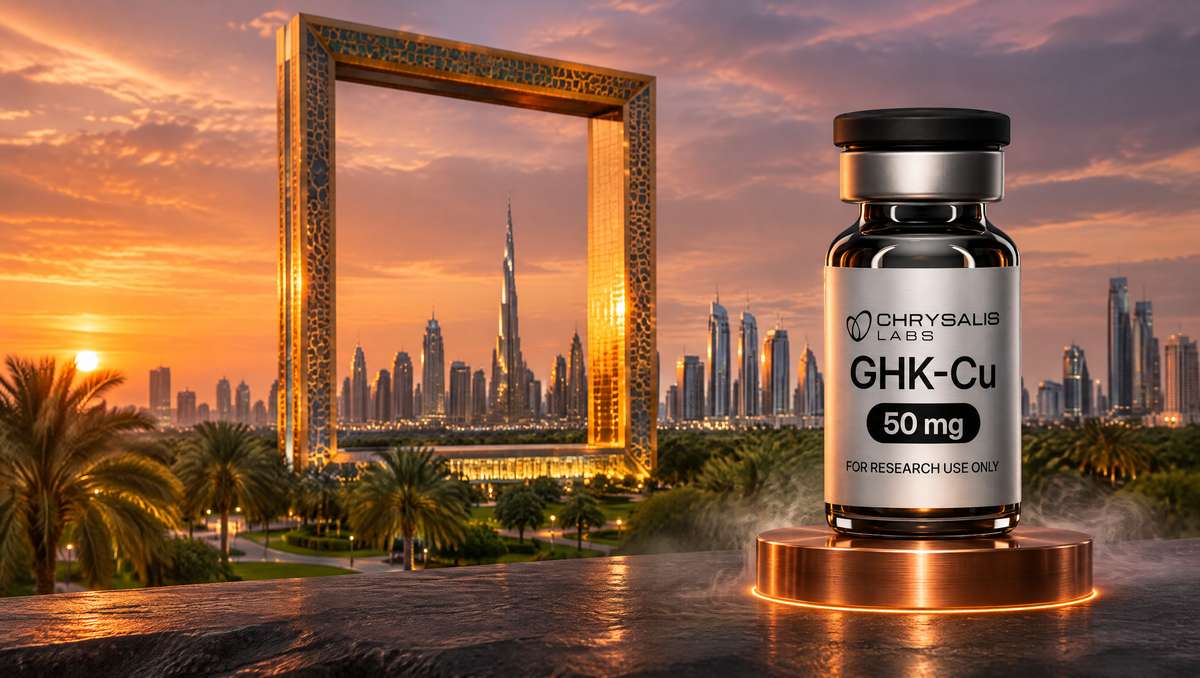
Up to about 16 mg of every 100 mg on a GHK-Cu label is copper, not peptide. What the number holds, and how to put a 50 mg and a 100 mg unit on one price scale.
They share a vial and a plus sign, not a molecule: BPC-157 is 15 amino acids, and TB-500 is either a 7-amino-acid fragment or the full thymosin beta-4. Here is how they compare, and what “5 mg + 5 mg” really counts.
A solid puck, a cracked one, loose crumbs, a faint film, even blue. What each look tells you, and the few worth a message.
Catalogues often use the two names as one. The molecules behind them differ by 36 amino acids and more than 4,000 g/mol.
On a mass spec, PT-141 lands just 0.02 from a peak of its near-twin, Melanotan II. Seven amino acids, a 23-atom ring, and how to tell which one a report shows.
Two seven-bead lab peptides. They start differently and end with the same three beads.
They sit side by side in research catalogues, yet they are built from different parts. One has no amino acids at all. The other is nothing but amino acids.
Fifteen letters, GEPPPGKPADDAGLV, are the whole identity of BPC-157. Learn to read them and you can check any lab report against them.
The same AED 25 from the Corniche to Liwa, and arrival days you can count before you order.
The fee is 5% with an AED 20 minimum, and sprays are out. Here is the arithmetic behind the total you hand the courier.
Two of the same item, and the third is free. What “the same” means, and the cart size where 15% off beats it.
Swap the first of three building blocks and you get a new molecule: three extra atoms, same copper grip.
It ships in the same vials and pens as peptides, yet it belongs to another family of molecules.
Same four amino acids, two spellings, and a split that traces back to one journal. A similar name, Epithalamin, is something else.
Four parts, one sealed solution, and a number on the label that tells you less than it seems to.
The percentage on a peptide lab report measures area on a chart. Here is how the machine draws it, how to read it and what it misses.
No vial goes bad at midnight on a printed date. A dry peptide keeps changing slowly, and you can name what sets the speed.
About 90 mg of benzyl alcohol per 10 mL vial is what sets the two apart. And “0.9%” on a label can mean that preservative or plain salt.
Same molecule, same 10 mg on the label, three containers. One of them goes straight into the fridge, and one is the only format you can’t pay for at the door.
Sixteen amino acids, coded in the DNA of the cell's power plants. Here is what it is, where its code sits and what a lab checks.
Short chains of amino acids, built in a lab one link at a time. Here is what that means, in plain words.
Three small building blocks hold one copper ion. That copper is why the powder is blue.
Who we are, delivery, payment, ordering, and seven checks for any seller.
Try a compound name, such as GHK-Cu.
Understand the catalogue’s stated scope and limits.