

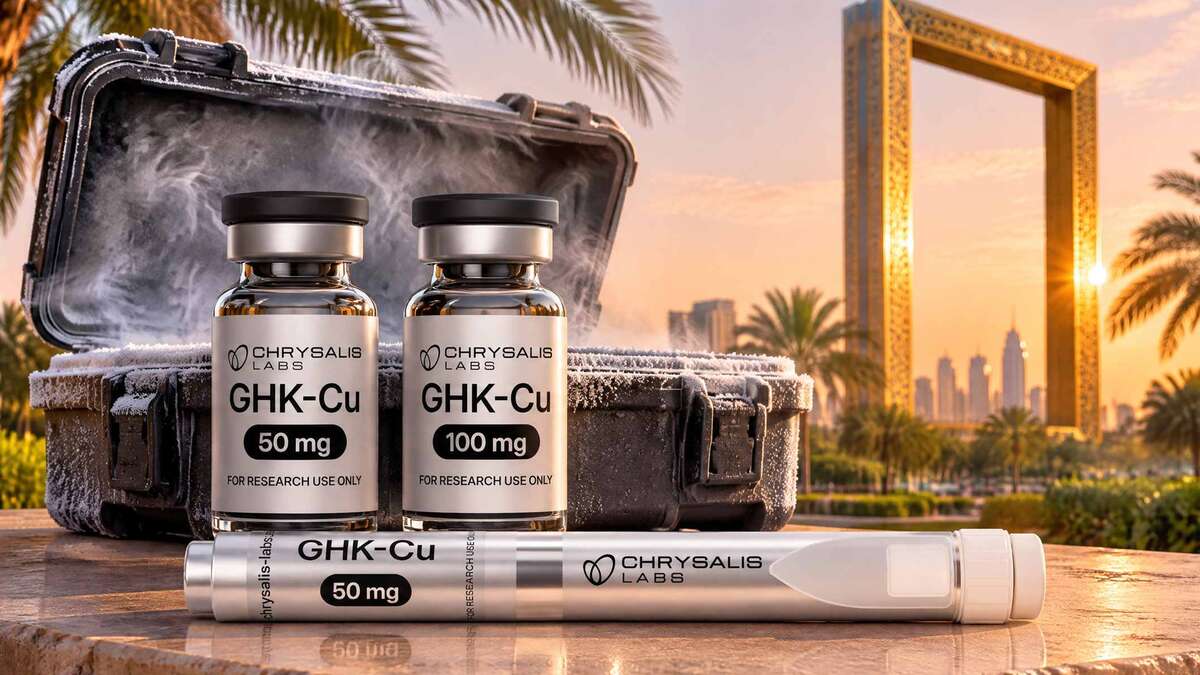
GHK-Cu sizes: 50 mg, 100 mg, vial or pen
Up to about 16 mg of every 100 mg on a GHK-Cu label is copper, not peptide. What the number holds, and how to put a 50 mg and a 100 mg unit on one price scale.
Everything on this site is supplied strictly for in-vitro laboratory research. Not for human or veterinary use.
See our Research Use Only policy (opens in a new tab)For research use only


Research areas
Strictly for in-vitro laboratory research. Not for human or veterinary use.

The short answer
PT-141 is a lab-made peptide of seven amino acids, six of them tied into a ring, with the formula C50H68N14O10 and a molecular weight of 1025.2 g/mol.1 It is a ring-shaped analogue of alpha-MSH, a natural hormone of 13 amino acids,2 and it differs from its near-twin Melanotan II only at the tail end of the chain.1,3
Chrysalis Labs lists PT-141 in all three formats, each at 10 mg: a Vial, a Pen and a Spray (as of 17 Nov 2026).
Strictly for in-vitro laboratory research. Not for human or veterinary use.
Chemistry from PubChem, read on ;1 listing as of .
Seven amino acids. Read from the front of the chain to the tail, the way peptides are written,4 they are norleucine, aspartic acid, histidine, D-phenylalanine, arginine, tryptophan and lysine.1
PT-141, as written
Ac-Nle-cyclo[Asp-His-D-Phe-Arg-Trp-Lys]-OH
Five of the seven are standard protein building blocks. Two are not.
The ends differ. The front carries an acetyl cap, written Ac;1,7 the tail ends in a free acid, –COOH, written –OH.1,6
PubChem writes its twin, Melanotan II, as Ac-Nle-Cyclo[Asp-His-D-Phe-Arg-Trp-Lys]-NH2.3 Swap that –NH2 tail for –OH and you have PT-141; the square brackets hold the ring. How to read a peptide sequence decodes strings like this.
With one extra bond. Every link in a peptide chain is an amide bond, joining the acid group of one amino acid to the amine group of the next.4 PT-141 adds one more, sideways.
Aspartic acid has a spare acid group on its side chain, and lysine a spare amine group.5 In PT-141 the two are joined, tying amino acid 2 to amino acid 7 and pulling six of the seven into a loop.1 An amide that closes a ring is a lactam.8
The names spell it out. One PubChem name for PT-141 lists the seven amino acids and ends in “(2→7)-lactam”: a bridge from the second to the seventh. The systematic name ends in “hexazacyclotricosane-23-carboxylic acid”: a ring of 23 atoms (cyclotricosane), six of them nitrogen (hexaza), with the acid on ring atom 23.1
The ring has a birth year. In December 1989, a University of Arizona paper described seven shortened, ring-shaped versions of alpha-MSH, with rings of 20 to 24 atoms.2 PT-141 carries the 23-atom ring from that work; Melanotan II carries the same ring with an amide tail. Melanotan II vs PT-141: one ring, two ends lines them up atom by atom.
C50H68N14O10: 50 carbon, 68 hydrogen, 14 nitrogen and 10 oxygen atoms, 142 in all.1
What PT-141 weighs, element by element
1025.2g/mol, molecular weight
C50H68N14O10 · exact mass 1024.52
Two weights, both right. The molecular weight, 1025.2 g/mol, uses the average weight of each element in nature. The exact (monoisotopic) mass, 1024.52, uses only the most common form of each atom.1 Check which of the two a report quotes.
Seven handed atoms. Each of its seven amino acids has one carbon that can take a left- or a right-handed form. PT-141's systematic name labels all seven: six S, one R.1 In protein amino acids, L nearly always comes out as S,9 so the lone R marks the D-phenylalanine.
Peptide alone, or with a partner. Synthetic peptides can keep small charged partners, called counter-ions, from their making or clean-up.10 PubChem keeps a separate record for PT-141 paired with one acetic acid: C52H72N14O12, 1085.2 g/mol, CAS 1607799-13-2.11 If a label or certificate names the acetate, see whether it gives 1085.2 (the pair) or 1025.2 (PT-141 alone).
How many molecules are in 10 mg? Divide 10 mg by 1025.2 g/mol: 9.75 micromoles. Times the Avogadro constant, 6.022 × 10²³ per mole,12 that is about 5.9 × 10¹⁸ molecules of PT-141 alone: nearly six billion billion (our arithmetic).
Match the paper first: name, CAS number (a chemical ID number), formula and weight, as in the box at the top. Then the identity test.
Weighing by mass spec. An electrospray mass spec gives molecules a charge, mostly by adding hydrogen ions, then sorts them by mass divided by charge.13 PT-141 with one extra hydrogen ion lands near 1025.53; with two, near 513.27 (our arithmetic).1,14
The one-unit trap. Melanotan II has an exact mass of 1023.54,3 so with one hydrogen ion it lands near 1024.55, about one unit lighter than PT-141. Easy to tell apart, until carbon-13 joins in.
About 1.07% of all carbon is the heavier carbon-13.15 With 50 carbons per molecule, roughly 4 molecules in 10 carry at least one, so every peak has a neighbour one unit heavier. Melanotan II's neighbour lands at 1025.55, just 0.02 from PT-141's main peak: a gap of about 1 part in 53,000 (our arithmetic).
PT-141 and Melanotan II on a mass spec, one charge
0.02 apart: the main peak of PT-141 and the neighbour of Melanotan II
So read the first peak of the cluster. For PT-141 the first strong peak sits near 1025.5, with its own neighbours at 1026.5 and up. A strong peak near 1024.5 points to Melanotan II.
Purity is a separate question. An HPLC purity figure says how much of the sample is the main compound, not which compound it is. Purity and identity: two different questions · How to read a certificate of analysis
All three, each at 10 mg. Only two other compounds in our catalogue, Semax and Selank, come in all three.
One molecule, three formats
Powder or solution. A Vial holds PT-141 dry and a Pen holds it dissolved, so they are kept differently: a sealed Vial at room temperature for short periods or at −20 °C for the long term, away from light; a Pen in the fridge at 2–8 °C from the day it arrives. Peptide vial, pen or spray: the difference explains why.
Each product page shows the current price in AED.
Delivery is the same for all three formats. AED 25 in every emirate, free from AED 350 of products after discounts. Dubai and Sharjah orders placed before 14:00 usually arrive the next working day. Abu Dhabi, Ajman, Umm Al Quwain, Ras Al Khaimah and Fujairah take 1–2 working days; Al Dhafra (Western Region) 2–3. Working days run Monday to Saturday, excluding UAE public holidays; times are estimates. Delivery zones and charges
Ordering to the capital? Research peptides in Abu Dhabi: delivery covers it in detail.
Payment depends on the format. Cash on delivery covers the Vial and the Pen: 5% of the product subtotal after discounts, minimum AED 20. An order with a Spray in it has no cash on delivery. Instalments or crypto show at checkout.
Buy 2, get 1 free applies to all three: pay for two of the same item, say two PT-141 Pens, and the third is free. A Vial plus a Pen does not count. One free item per order.
Delivery, payment and offer as of . For researchers aged 21 and over, with a UAE address.
A lab-made, ring-shaped peptide of seven amino acids, with the formula C50H68N14O10 and a molecular weight of 1025.2 g/mol. It is an analogue of alpha-MSH, a natural hormone of 13 amino acids. Strictly for in-vitro laboratory research. Not for human or veterinary use.
Ac-Nle-cyclo[Asp-His-D-Phe-Arg-Trp-Lys]-OH: norleucine, aspartic acid, histidine, D-phenylalanine, arginine, tryptophan and lysine, with an acetyl cap, an acid tail and a ring from aspartic acid to lysine.
1025.2 g/mol, with an exact mass of 1024.52 (PubChem). Paired with one acetic acid, it is 1085.2 g/mol. On an electrospray mass spec, PT-141 shows near 1025.53 with one charge.
By the first strong peak: near 1025.53 for PT-141 and 1024.55 for Melanotan II, with one charge. Melanotan II’s carbon-13 neighbour lands just 0.02 from PT-141, so a strong peak near 1024.5 means Melanotan II (our arithmetic).
For the Vial and the Pen, yes: 5% of the product subtotal after discounts, minimum AED 20. Not for the Spray, or any order with a Spray in it.
Chrysalis Labs delivers to all seven emirates, for researchers aged 21 and over. Dubai orders placed before 14:00 usually arrive the next working day; Abu Dhabi takes 1–2 working days (Al Dhafra 2–3). Delivery is AED 25, free from AED 350. Each product page shows the current stock.
Our own pages: Delivery zones and charges · FAQ · the catalogue
Delivered to all seven emirates. Cash on delivery on the Vial and the Pen.
Strictly for in-vitro laboratory research. Not for human or veterinary use.
Chrysalis Labs Research Team · Facts checked
Up to about 16 mg of every 100 mg on a GHK-Cu label is copper, not peptide. What the number holds, and how to put a 50 mg and a 100 mg unit on one price scale.
They share a vial and a plus sign, not a molecule: BPC-157 is 15 amino acids, and TB-500 is either a 7-amino-acid fragment or the full thymosin beta-4. Here is how they compare, and what “5 mg + 5 mg” really counts.
Catalogues often use the two names as one. The molecules behind them differ by 36 amino acids and more than 4,000 g/mol.