

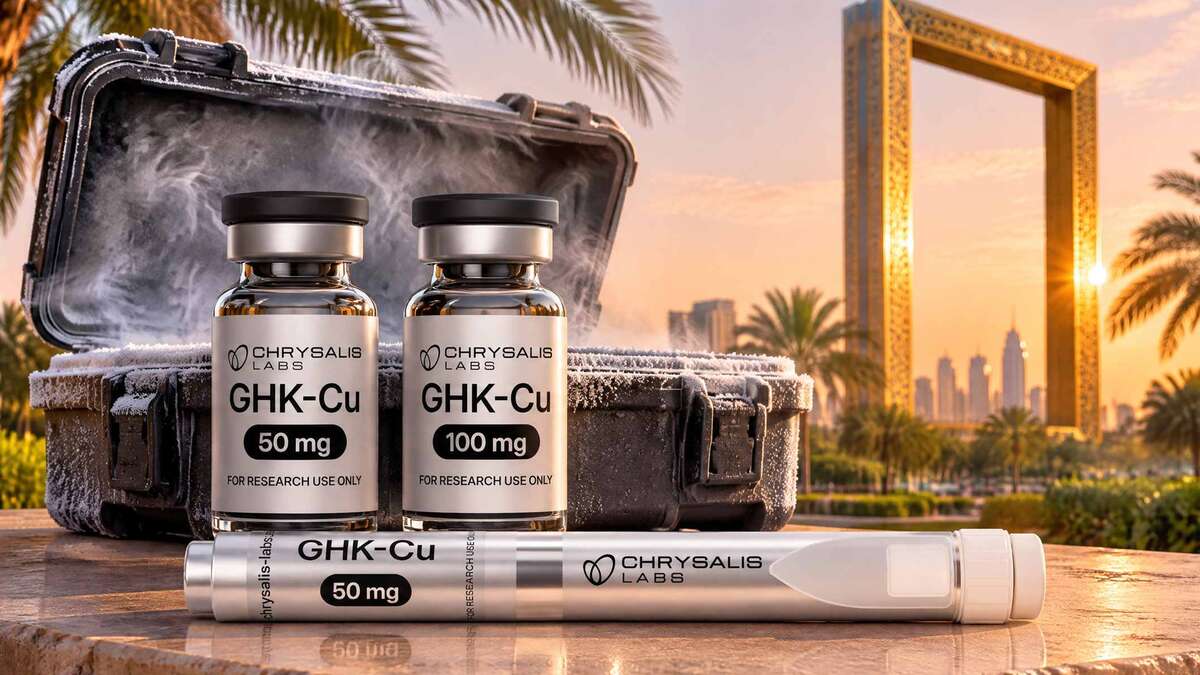
GHK-Cu sizes: 50 mg, 100 mg, vial or pen
Up to about 16 mg of every 100 mg on a GHK-Cu label is copper, not peptide. What the number holds, and how to put a 50 mg and a 100 mg unit on one price scale.
Everything on this site is supplied strictly for in-vitro laboratory research. Not for human or veterinary use.
See our Research Use Only policy (opens in a new tab)For research use only


Research areas
Strictly for in-vitro laboratory research. Not for human or veterinary use.

The short answer
Thymosin beta-4 is a natural peptide of 43 amino acids.1 TB-500 is a product name: two lab papers from 2012 tie it to a 7-amino-acid piece of that chain, positions 17 to 23, with an acetyl cap.2,3
The full chain weighs 4,963 g/mol, the capped piece 889.0.5,6 One number on a batch's identity test tells them apart.
Strictly for in-vitro laboratory research. Not for human or veterinary use.
Thymosin beta-4 was first isolated from calf thymus.7 Its sequence came out in 1981: 43 amino acids, with an acetyl cap on the first one.1
Key words. An amino acid is one bead in a peptide chain, with a one-letter code: K is lysine. An acetyl cap is a small chemical group on a chain's first amino acid, written “Ac-”. And g/mol, grams per mole, says how heavy a molecule is.
Ten years later, a platelet team sequenced a peptide they called “Fx”. It matched thymosin beta-4 letter for letter. It holds actin, a protein of the cell's inner framework, one to one, and it turns up in many cell types.7
UniProt files it under the gene TMSB4X.4 Papers write Tβ4; catalogues write TB4. PubChem gives 4,963 g/mol.5
Epithalon and Epitalon are one molecule spelled two ways. TB-500 and thymosin beta-4 are two names for two molecules.
TB-500 is a product name. In PubMed it first appears in 2012, in two lab papers on products sold under it.
The lab in Belgium used high-resolution mass spectrometry and identified Ac-LKKTETQ: positions 17 to 23 of thymosin beta-4 with an acetyl cap. It also made the peptide by synthesis.2
The lab in Hong Kong called TB-500 a synthetic version of one region of thymosin beta-4. Its key ingredient: LKKTETQ with an acetyl group added to the front.3 PubChem now lists “TB-500” among the names of that peptide, at 889.0 g/mol.6
Two names, two molecules
36 amino acids and more than 4,000 g/mol apart
Those papers describe the samples those labs held. For any other vial with the name on it, the batch document has the final word.
Write thymosin beta-4 as 43 letters, one per amino acid, and count from the left. Letters 17 to 23 read L-K-K-T-E-T-Q: leucine, lysine, lysine, threonine, glutamic acid, threonine and glutamine.4,6 New to one-letter codes? How to read a peptide sequence covers them.
Thymosin beta-4, bead by bead
43 amino acids · 4,963 g/mol
Places 17 to 23, LKKTETQ: the piece found in TB-500, with an acetyl cap, 889.0 g/mol
Read “17–23” as an address. The piece starts at position 17 and is seven letters long. Sixteen letters come before it and twenty after; the fragment carries none of those 36.
The stretch was mapped long before 2012. In 1996 a team made variants of the full chain and found two parts involved in binding actin: positions 1 to 16, and a six-letter stretch at 17 to 22.8 A 2010 overview calls 17 to 23 the central actin-binding domain.10
A numbering trap. UniProt lists the chain as the gene writes it: 44 amino acids, starting with a methionine the cell removes. Its numbers run one higher, so the same seven letters sit at 18 to 24 there.4
The full chain weighs 4,963 g/mol and the capped fragment 889.0 g/mol.5,6 Thymosin beta-4 is about 5.6 times heavier. By count, the fragment is 7 of the 43 amino acids, about one-sixth of the chain.
Three weights from one database
The third bar is the same seven letters without the cap: LKKTETQ, 847.0 g/mol on PubChem.9 The acetyl cap accounts for the 42 between them.
Keep these three numbers in mind. An identity test checks a sample's mass against numbers like these.
Before you lean on a paper, find the line that names the material. A finding about the 43-amino-acid chain belongs to that chain. A shared catalogue name does not carry it over to a 7-letter piece.
Seven papers and the material each one names
The split is clean. Up to 1996 the material is the full chain. The capped fragment arrives in 2012, with work on products sold as TB-500. The 2024 paper names the gap: earlier activity work on this stretch used the uncapped form, and the capped form's own activity had not been documented.11
One number does the work: the mass. Identity is usually checked by mass spectrometry, a test that weighs molecules; the Belgian lab found the fragment that way.2 On a certificate of analysis (COA), find the identity test and the mass it reports.
PubChem values, in g/mol.5,6,9 No rounding blurs a gap that wide.
Purity is a separate question. Usually measured by HPLC, it says how much of a sample is the main compound. It does not say which molecule that compound is. Read both lines.
Chrysalis Labs is lab-verified.
Purity and identity: two different questions · How to read a certificate of analysis
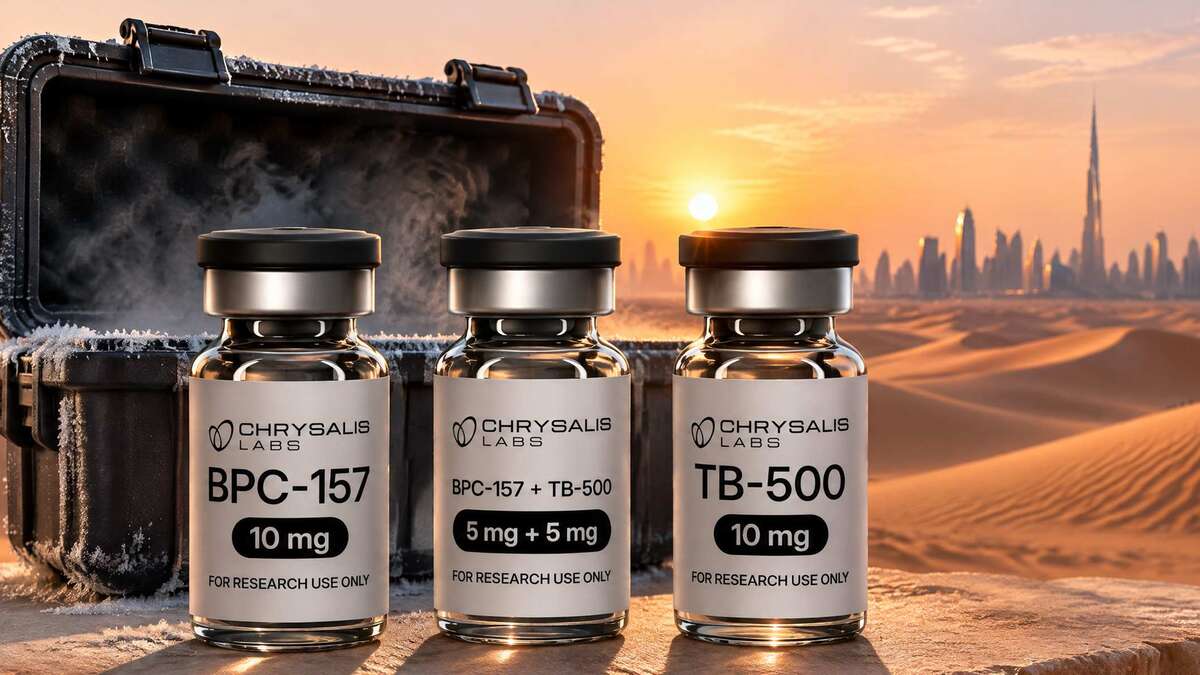
As of 17 Nov 2026, Chrysalis Labs lists TB-500 as a 10 mg Vial and a 10 mg Pen. It is also one half of BPC-157 + TB-500, listed as a 5 mg + 5 mg Vial and a 5 mg + 5 mg Pen. The other half is a separate peptide; What is BPC-157? takes it apart.
A Vial arrives as dry powder, a Pen as a solution; the 10 mg is the same. Peptide vial, pen or spray covers the rest. Each product page shows the current price in AED.
Delivery and payment, as of 17 Nov 2026. Delivery is AED 25 in every emirate, free from AED 350 of products after discounts. Dubai and Sharjah orders placed before 14:00 usually arrive the next working day. Other emirates take 1–2 working days, and Al Dhafra (Western Region) 2–3. Times are estimates. Cash on delivery covers Vials and Pens, with a fee of 5% of the product subtotal after discounts, minimum AED 20.
Buy 2, get 1 free, as of 17 Nov 2026. Pay for two of the same item (same compound, same format, same amount) and the third one is free. One free item per order.
No. Thymosin beta-4 is a natural peptide of 43 amino acids. Two lab papers published in 2012 tie the name TB-500 to a 7-amino-acid piece of it: positions 17 to 23, with an acetyl cap.
TB4 (or Tβ4) is short for thymosin beta-4, the full 43-amino-acid chain. TB-500 is a product name the 2012 papers tie to a 7-amino-acid fragment of it. Catalogues sometimes swap the names, so check the mass on the batch document.
Seven amino acids from the middle of the 43: LKKTETQ. Read 17-23 as an address: the piece starts at position 17 and ends at 23. With an acetyl cap it is Ac-LKKTETQ, the peptide the 2012 papers tie to TB-500.
PubChem lists 889.0 g/mol for the capped fragment Ac-LKKTETQ, which has TB-500 among its listed names, and 4,963 g/mol for thymosin beta-4. Without the cap, the fragment is 847.0 g/mol.
Thymosin beta-4 has 43; the peptide found in TB-500 in 2012 has 7. UniProt shows 44 because it counts a first methionine the cell removes.
Chrysalis Labs lists it under the name TB-500, as a 10 mg Vial and a 10 mg Pen (as of 17 Nov 2026); thymosin beta-4 has no listing of its own. It ships to all seven emirates for AED 25, or free from AED 350 of products, to researchers aged 21 and over. Strictly for in-vitro laboratory research. Not for human or veterinary use.
Our own pages: TB-500 compound profile · Delivery zones and charges · FAQ · the catalogue
Listed as a 10 mg Vial and a 10 mg Pen. Delivered across all seven emirates. Cash on delivery on Vials and Pens.
Strictly for in-vitro laboratory research. Not for human or veterinary use.
Chrysalis Labs Research Team · Facts checked
Up to about 16 mg of every 100 mg on a GHK-Cu label is copper, not peptide. What the number holds, and how to put a 50 mg and a 100 mg unit on one price scale.
They share a vial and a plus sign, not a molecule: BPC-157 is 15 amino acids, and TB-500 is either a 7-amino-acid fragment or the full thymosin beta-4. Here is how they compare, and what “5 mg + 5 mg” really counts.
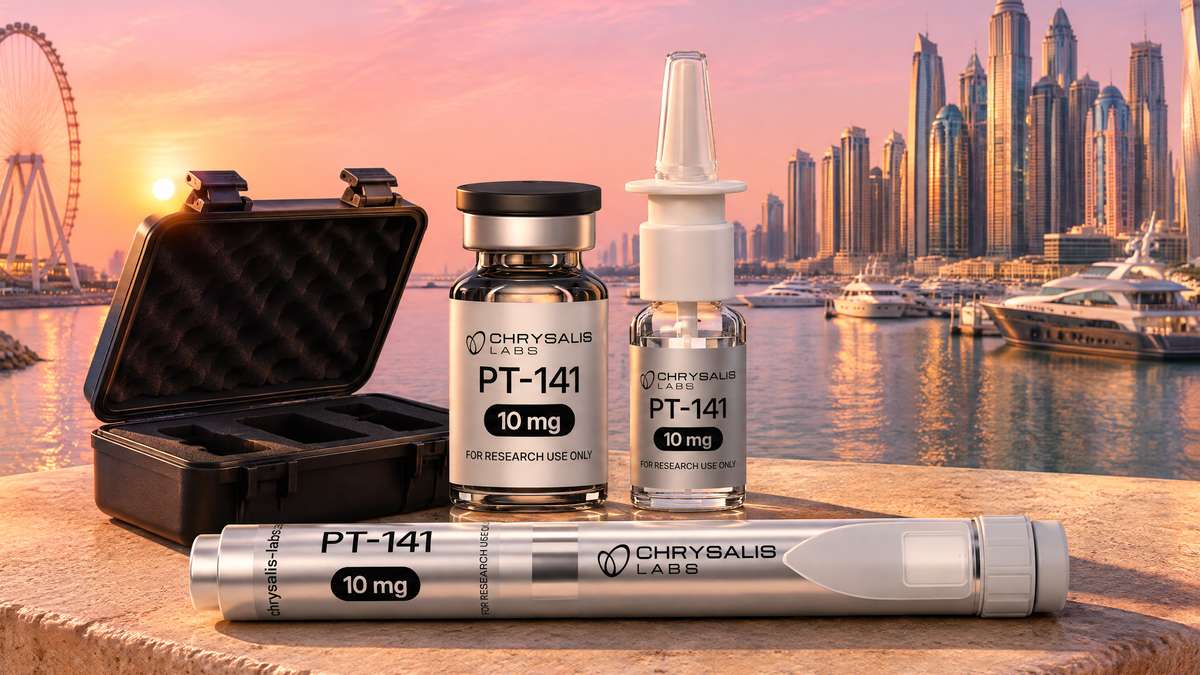
On a mass spec, PT-141 lands just 0.02 from a peak of its near-twin, Melanotan II. Seven amino acids, a 23-atom ring, and how to tell which one a report shows.