

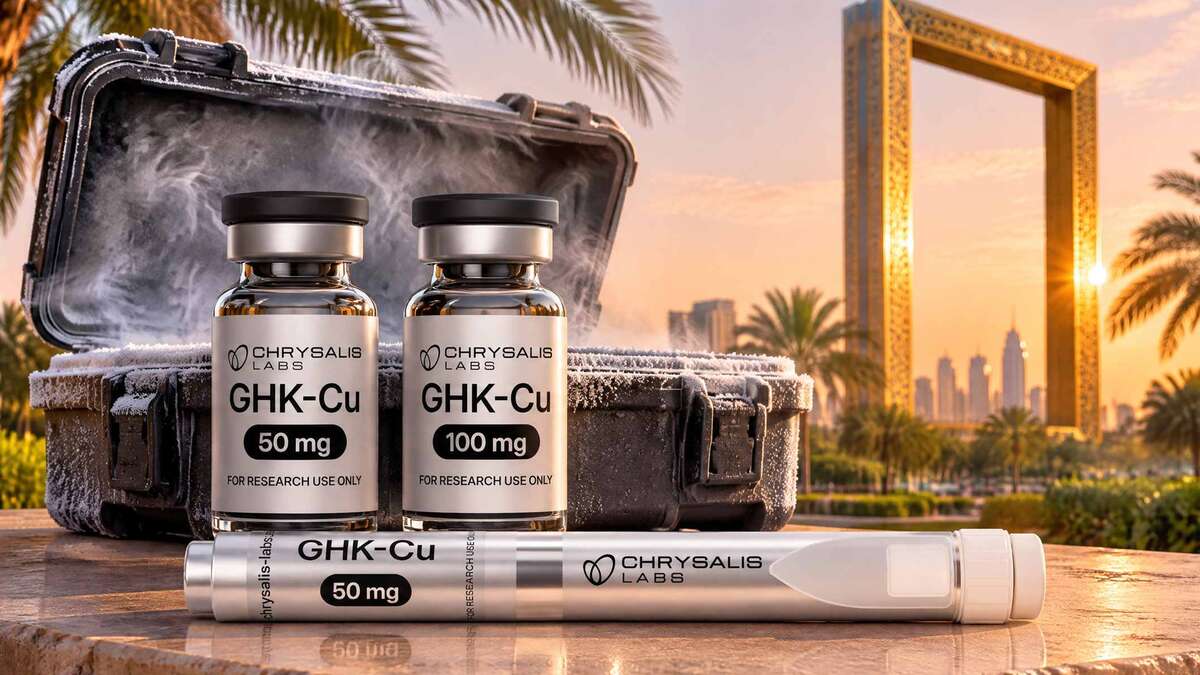
GHK-Cu sizes: 50 mg, 100 mg, vial or pen
Up to about 16 mg of every 100 mg on a GHK-Cu label is copper, not peptide. What the number holds, and how to put a 50 mg and a 100 mg unit on one price scale.
Everything on this site is supplied strictly for in-vitro laboratory research. Not for human or veterinary use.
See our Research Use Only policy (opens in a new tab)For research use only


Research areas
Strictly for in-vitro laboratory research. Not for human or veterinary use.

The short answer
Epithalon and Epitalon are the same peptide: four amino acids, Ala-Glu-Asp-Gly (AEDG), with the formula C14H22N4O9 and a molecular weight of 390.35 g/mol.1 Neither spelling is wrong, and research papers use both.2,4
The name to watch is Epithalamin. It is a different thing: a pineal gland extract from cattle, a mixture of many peptides.2 Chrysalis Labs lists Epithalon as a 10 mg Vial and a 10 mg Pen (as of 17 Nov 2026).
Strictly for in-vitro laboratory research. Not for human or veterinary use.
Chemistry from PubChem;1 the extract from the 2025 overview;2 listing as of .
Both. Same molecule, same vial. PubChem, the public chemistry database of the US National Library of Medicine, files it under “Epitalon” and lists “Epithalon” and “Epithalone” as other names on the same record. Type any of the three into its search and you land on one entry, CID 219042.1
A 2025 overview in the International Journal of Molecular Sciences opens the same way: Epitalon, also known as Epithalon or Epithalone, is the tetrapeptide Ala-Glu-Asp-Gly.2 The sequence tells you what is inside, whatever the spelling. Our label reads Epithalon, and it is the product you searched for as Epitalon.
Seven names you may see, one question each
| Name you may see | Same molecule? | What it is |
|---|---|---|
| Epithalon | Yes | One spelling of the four-amino-acid peptide. The one on our label |
| Epitalon | Yes | The other spelling. PubChem's record title, and the one newer papers prefer1,4 |
| Epithalone | Yes | A third, rare spelling1,2,4 |
| Ala-Glu-Asp-Gly | Yes | The sequence, in three-letter codes1 |
| AEDG | Yes | The same sequence, in one-letter codes3 |
| CAS 307297-39-8 | Yes | The main registry number on the PubChem record1 |
| Epithalamin | No | An extract from the pineal gland of cattle. A mixture of peptides2 |
Four words used below. An amino acid is one building block of a peptide, like a bead on a string. A tetrapeptide is a peptide made of four amino acids. An extract is material taken out of a tissue; it holds many substances at once. Mass spec is a test that weighs molecules to confirm what they are.
Follow the journals. On 17 Nov 2026, PubMed, the US index of journal papers, held 64 records with “Epitalon” in the title, abstract or keywords, and 56 with “Epithalon”.4 Close numbers. Where they sit is the interesting part.
Where each spelling lives
36 of the 56 “Epithalon” records come from a single journal: the Bulletin of Experimental Biology and Medicine, the English edition of a Russian journal.4,5 Not one of the 64 “Epitalon” records is from it. In titles alone the split is sharper still: 16 of the 19 “Epithalon” titles are from that journal.4
Time shows the rest. Both spellings reach PubMed in 2000. Since 2015, 16 records use Epitalon and only 4 use Epithalon.4
Our reading: “Epithalon” is largely the house spelling of one translated journal in the early 2000s, and its “th” echoes the extract's name, Epithalamin. The wider literature has moved to “Epitalon”. Neither changes a single atom.
Searching papers? Add “AEDG” to both spellings. It catches papers that skip the names, like a 2017 title that says only “peptide AEDG”.6 Skim the hits: AEDG is also an acronym in a few underwater-sensor engineering papers.4
Four amino acids in a fixed order: alanine, glutamic acid, aspartic acid, glycine. In three-letter codes that is Ala-Glu-Asp-Gly; in one-letter codes, AEDG.1,3 Four amino acids make it a tetrapeptide.
Epithalon = Epitalon, bead by bead
4 amino acids · 390.35 g/mol
The two middle beads carry a negative charge on their side chains
The weight checks out on paper. Each time two amino acids join, one molecule of water leaves.7 Four amino acids, three joins, three waters. PubChem lists the four at 89.09, 147.13, 133.10 and 75.07 g/mol, which is 444.39 together. Take away 3 × 18.015 and you get 390.345, the 390.35 g/mol PubChem gives for the finished chain.1,8
The atoms balance too. The four loose amino acids add up to C14H28N4O12. Remove three H2O and you have C14H22N4O9, the formula on the record.1,8 The two middle beads, glutamic and aspartic acid, carry side chains with a negative charge.7
No. Epithalamin is an extract. Epithalon is one defined molecule. Epithalamin comes from the pineal gland of cattle,2 a tiny gland in the brain.10 In 2017 a team in St Petersburg ran a pineal peptide extract of this kind through mass spec and HPLC and sorted what they found by chain length:6
One pineal extract, sorted by chain length
AEDG turned up among the chains of four.6 The order of events is the surprise. The peptide was designed first, from the amino acid make-up of the extract, and made by synthesis. It was found inside the extract only later.2
The trap: PubChem lists “Epithalamin” among the other names on the tetrapeptide's record, and searching PubChem for “Epithalamin” opens that same record. The record even carries a second registry number, 64082-79-7, filed under that name.1
In the papers, Epithalamin means the extract, with a literature of its own: 71 PubMed records.2,4 A finding about the extract does not automatically carry over to the synthetic peptide, which is why our Epithalon compound profile keeps them apart.
Four identifiers stay the same under every spelling:1
A different sequence, formula or weight means a different molecule. One amino acid is enough: GHK-Cu and AHK-Cu differ by a single bead and are two compounds. Most peptides today are made by solid-phase synthesis, and two of its common flaws are exactly that: a chain with an amino acid missing, or an extra one.9
On a mass spec report, look for 391.15. The molecule's exact mass is 390.139 Da.1 Mass spec usually shows it carrying one extra proton, written [M+H]+,12 and a proton weighs 1.00728 Da.11 So the AEDG peak sits near 391.15. A chain that lost its glycine would sit about 57 lower, near 334.12. Both figures are our arithmetic from PubChem and NIST values.8,11
Purity is a separate question, usually measured by HPLC. And the “10 mg” on a label is the amount of compound in that one unit. Chrysalis Labs is lab-verified.
Purity and identity: two different questions · How to read a certificate of analysis
At Chrysalis Labs, Epithalon is listed in two formats, 10 mg each, as of :
Epithalon as a Vial and as a Pen
Both product pages describe it in one line: “Tetrapeptide with the amino acid sequence Ala-Glu-Asp-Gly.” Each shows the current AED price and stock. The two formats side by side: Peptide vial, pen or spray: the difference.
Keeping them: sealed Vials are fine at room temperature for short periods and go in a freezer at −20 °C for the long term, away from light. Pens go in the fridge, at 2–8 °C, from the day they arrive.
Delivery and payment work the same for both formats, as of 17 Nov 2026. Delivery is AED 25 in every emirate, free from AED 350 of products after discounts. Dubai and Sharjah orders placed before 14:00 usually arrive the next working day. Other emirates take 1–2 working days, and Al Dhafra (Western Region) 2–3. Times are estimates.
Cash on delivery covers Vials and Pens, with a fee of 5% of the product subtotal after discounts, minimum AED 20. Buy 2, get 1 free: pay for two of the same item (two Vials or two Pens) and the third is free, one free item per order. Both as of 17 Nov 2026. Delivery zones and charges
Yes. They are two spellings of one peptide: four amino acids in the order Ala-Glu-Asp-Gly (AEDG), formula C14H22N4O9, molecular weight 390.35 g/mol.
Neither is wrong. PubChem titles its record Epitalon and lists Epithalon as another name. Newer papers lean to Epitalon: since 2015, PubMed holds 16 records with Epitalon and 4 with Epithalon (17 Nov 2026).
The spelling follows the journal. 36 of the 56 PubMed records with Epithalon come from the English edition of one Russian journal, the Bulletin of Experimental Biology and Medicine. None of the 64 records with Epitalon does.
No. Epithalamin is an extract from the pineal gland of cattle, a mixture of peptides. Epithalon is one defined chain of four amino acids, designed from the make-up of that extract and made by synthesis.
It is the sequence in one-letter codes: A for alanine, E for glutamic acid, D for aspartic acid, G for glycine. Ala-Glu-Asp-Gly is the same sequence in three-letter codes.
390.35 g/mol on PubChem, with the formula C14H22N4O9. The four amino acids weigh 444.39 together, and three waters (54.045) leave when they join.
Chrysalis Labs lists it as Epithalon, a 10 mg Vial and a 10 mg Pen, and delivers to all seven emirates for researchers aged 21 and over. Delivery is AED 25, free from AED 350, as of 17 Nov 2026. Strictly for in-vitro laboratory research. Not for human or veterinary use.
Our own pages: Epithalon Vial · Epithalon Pen · Epithalon compound profile · Delivery zones and charges · FAQ
A 10 mg Vial and a 10 mg Pen. Delivered across all seven emirates, cash on delivery available.
Strictly for in-vitro laboratory research. Not for human or veterinary use.
Chrysalis Labs Research Team · Sources read
Up to about 16 mg of every 100 mg on a GHK-Cu label is copper, not peptide. What the number holds, and how to put a 50 mg and a 100 mg unit on one price scale.
They share a vial and a plus sign, not a molecule: BPC-157 is 15 amino acids, and TB-500 is either a 7-amino-acid fragment or the full thymosin beta-4. Here is how they compare, and what “5 mg + 5 mg” really counts.
Catalogues often use the two names as one. The molecules behind them differ by 36 amino acids and more than 4,000 g/mol.