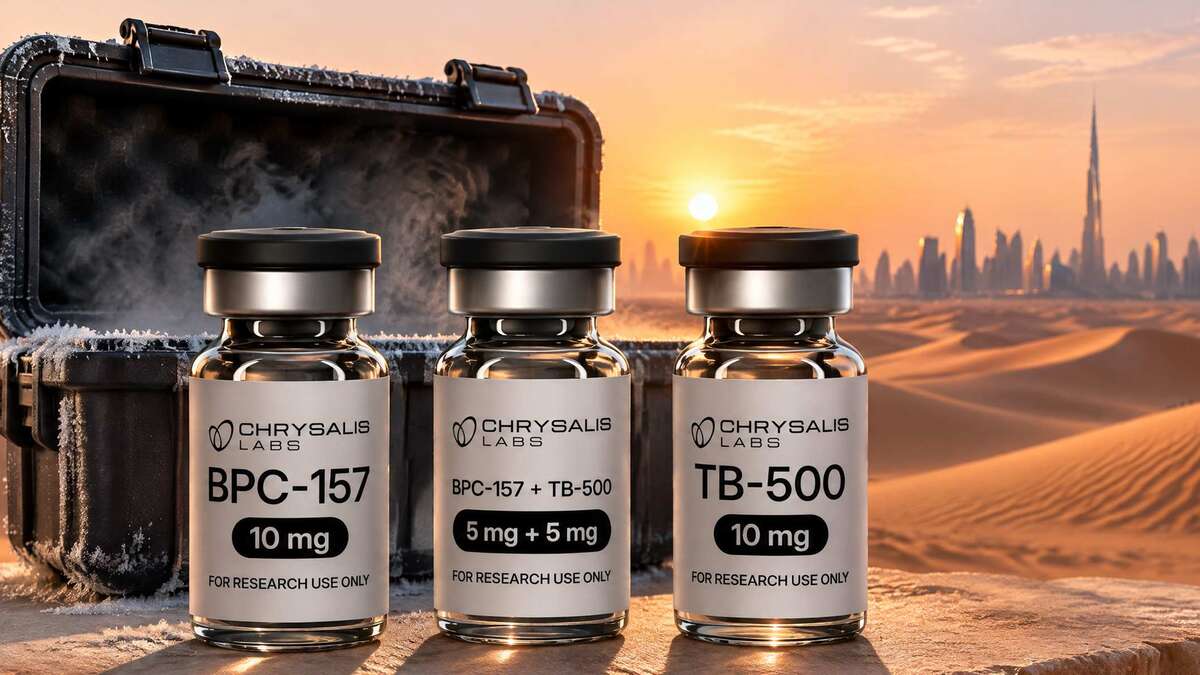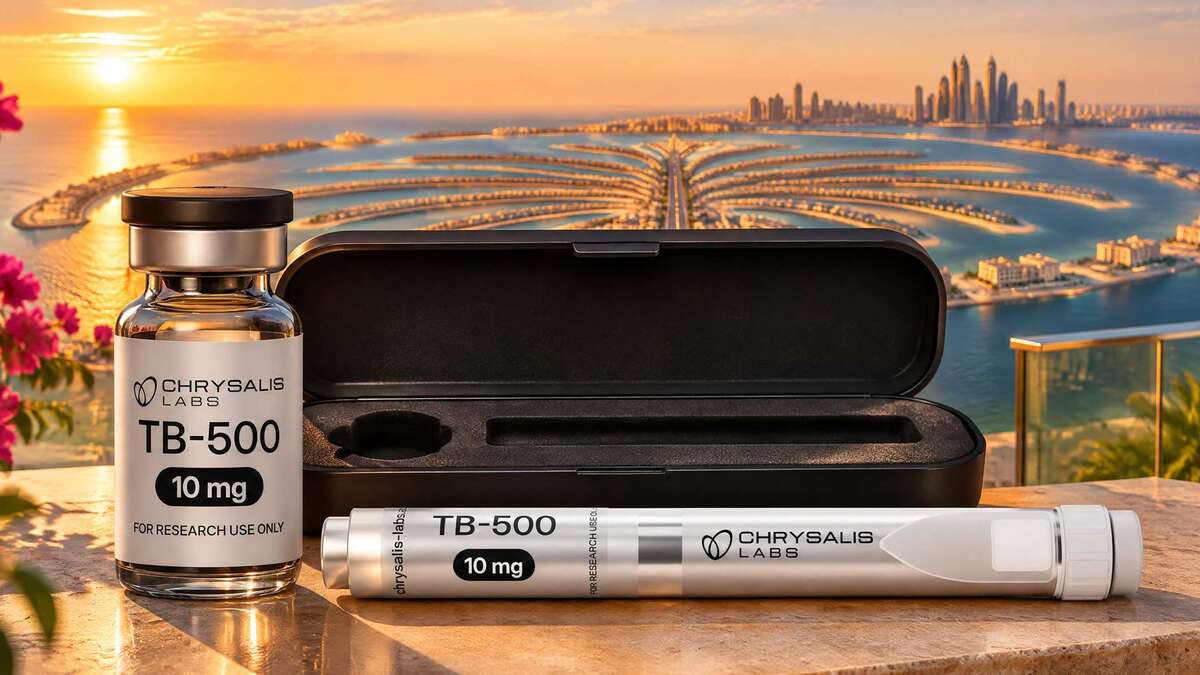


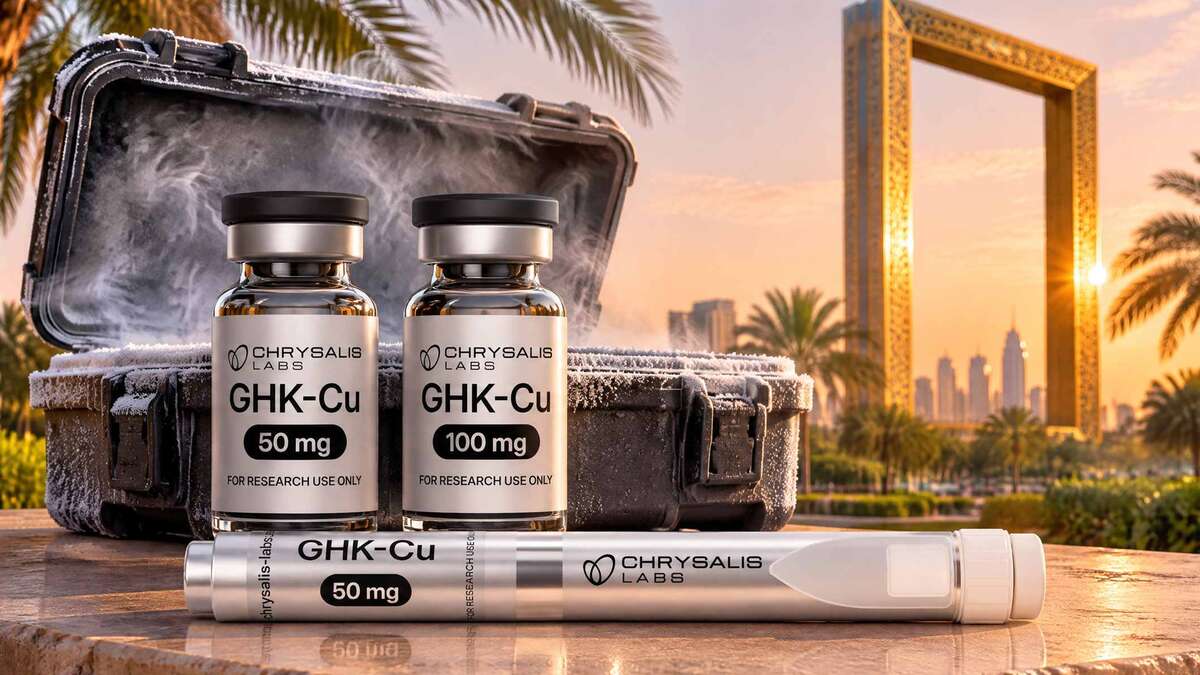
GHK-Cu sizes: 50 mg, 100 mg, vial or pen
Up to about 16 mg of every 100 mg on a GHK-Cu label is copper, not peptide. What the number holds, and how to put a 50 mg and a 100 mg unit on one price scale.
Everything on this site is supplied strictly for in-vitro laboratory research. Not for human or veterinary use.
See our Research Use Only policy (opens in a new tab)For research use only


Research areas
Strictly for in-vitro laboratory research. Not for human or veterinary use.

The short answer
GHK-Cu and AHK-Cu are two copper peptides that differ in a single amino acid: GHK-Cu starts with glycine (G), AHK-Cu with alanine (A), and both go on with histidine and lysine, holding one copper ion. That swap adds one carbon and two hydrogen atoms, so the AHK peptide weighs 354.41 g/mol against 340.38 for GHK.1,2
The copper grip and the blue are shared; the formula, the weight, the registry number and the paper trail are not.
Strictly for in-vitro laboratory research. Not for human or veterinary use.
Two molecules, ten facts side by side.
| Fact | GHK-Cu | AHK-Cu |
|---|---|---|
| First amino acid | Glycine (G) | Alanine (A) |
| The peptide | Glycine, histidine, lysine1 | Alanine, histidine, lysine2 |
| Peptide formula | C14H24N6O41 | C15H26N6O42 |
| Peptide weight | 340.38 g/mol1 | 354.41 g/mol2 |
| CAS number of the peptide | 49557-75-71 | 126828-32-82 |
| How it holds copper | Three nitrogen atoms, measured3 | Starts with the same pattern;4 not mapped on its own |
| Colour | Blue: takes in orange light at 606 nm5,6 | The pattern takes in light at about 600 nm4 |
| First paper | 1973: GHK discovered5,7 | 2007: first PubMed paper with the name8 |
| PubMed papers with the name | 859 | 19 |
| At Chrysalis Labs | Vial 50 mg or 100 mg · Pen 50 mg or 100 mg | Vial 100 mg · Pen 100 mg |
Each name is a parts list in the one-letter code for amino acids, the building blocks of every peptide: G is glycine, A is alanine, H is histidine and K is lysine.10 Cu is the chemical symbol for copper.
So GHK is glycine, then histidine, then lysine. AHK is alanine, then histidine, then lysine.1,2 Three amino acids in a row make a tripeptide; with one copper ion bound, it becomes the complex that goes into the vial.
Our product pages spell it out the chemists' way: “copper complex of the tripeptide glycyl-histidyl-lysine” for GHK-Cu, “copper complex of the tripeptide Ala-His-Lys” for AHK-Cu. The same code works for longer chains.
One small group of atoms at the front of the chain. Every amino acid has the same core and one part of its own, the side chain. Glycine's side chain is a single hydrogen atom. Alanine carries a carbon with three hydrogens in that spot.11
Swap one for the other and the peptide gains one carbon and two hydrogens: C14H24N6O4 becomes C15H26N6O4.1,2
One bead changes
+1 carbon, +2 hydrogen = +14.03 g/mol
Three extra atoms on a 48-atom peptide, 14.03 g/mol on 340.38: AHK is about 4% heavier (our sums from the two PubChem formulas). Histidine and lysine stay put. So does the copper, as the next section shows.
They start with the same grip, and the swap sits outside it. For GHK-Cu the grip has been measured: in water, three nitrogen atoms hold the copper, one at the very start of the chain, one in the joint between the first and second amino acid, and one in histidine's ring.3,5
A 2018 overview in Chemistry – A European Journal gives the rule behind it: a peptide that starts with one amino acid followed by histidine holds copper with those same three nitrogen atoms.4 AHK starts exactly that way.
The side chain where G and A differ is not one of the three. The same paper notes that side chains next to the histidine can change how tightly copper is held without binding it.4 Same grip, then, with a strength that may differ.
One gap: we found no paper on PubMed that maps the AHK-Cu complex itself, as GHK-Cu was mapped in 2011. For AHK-Cu this is the rule for the pattern, not a measurement.
No. The blue of a copper peptide comes from the copper and the atoms gripping it. White light holds every colour, and copper in this three-nitrogen grip takes in the orange part: at about 600 nm for the pattern,4 and at 606 nm measured on GHK-Cu.5 Your eye sees what is left, and that reads as blue.6
Both peptides use the same grip, so both should look blue. Blue says copper is being held. It can't say which peptide holds it, or anything about purity. A shade judged by eye through glass is no test at all.
By weight, and by name on paper. Three checks settle it.
Weigh like with like
Mass answers “which molecule is this?” How much of the sample is that molecule is a separate test, usually HPLC. Both questions side by side: Purity and identity.
On PubMed, GHK has a 34-year head start. It was found in human blood in 1973 by Pickart and Thaler.5,7 Its copper complex was studied in water in 1982 and the grip mapped in 2011.14,3
AHK-Cu is the newcomer: PubMed, the public index of journal papers, lists its name in one lab study, from 2007.8 Our search on 17 Nov 2026, name in the title or abstract, found 85 papers for GHK-Cu and 1 for AHK-Cu.9
Two paper trails
The count only catches papers that print the short name, and it says nothing about what they found.
Chrysalis Labs is a lab-verified online store in the UAE, delivering to all seven emirates. Both compounds come in both formats.
As listed on . Current AED price and stock: on each product page.
GHK-Cu has two sizes in each format. AHK-Cu comes at 100 mg, the size where the two line up one to one. A Vial holds freeze-dried powder in sealed glass, a Pen the compound already in solution.
Our storage guidance is the same for both: sealed Vials at room temperature for short periods and at −20 °C for the long term, away from light; Pens in the fridge at 2–8 °C from the day they arrive.
For every order, as of 17 Nov 2026: delivery is AED 25 to any emirate, free from AED 350 of products after discounts. Dubai and Sharjah orders placed before 14:00 usually arrive the next working day, other emirates in 1–2 working days, Al Dhafra (Western Region) in 2–3. Times are estimates.
Cash on delivery covers Vials and Pens, with a fee of 5% of the product subtotal after discounts, minimum AED 20. Buy 2, get 1 free: pay for two of the same item (same compound, format and amount) and the third is free, one per order. GHK-Cu and AHK-Cu count as different items.
The first amino acid: glycine in GHK-Cu, alanine in AHK-Cu. Histidine, lysine and the copper are the same. The swap adds one carbon and two hydrogens, so the AHK peptide weighs 354.41 g/mol against 340.38 for GHK.
No. They are two molecules with their own formula, weight and CAS number (49557-75-7 for GHK, 126828-32-8 for AHK). They share two of three amino acids and the copper grip.
One-letter codes for amino acids: G is glycine, A is alanine, H is histidine and K is lysine. Cu is the chemical symbol for copper.
No. Both hold copper with the same three nitrogen atoms, and that grip is where the blue comes from. Weight tells them apart: on a mass spectrometer AHK reads about 14 units heavier.
GHK-Cu, by far: 85 papers on PubMed with “GHK-Cu” in the title or abstract on 17 Nov 2026, against 1 for “AHK-Cu”. GHK was found in 1973; the AHK-Cu paper dates from 2007.
Chrysalis Labs lists GHK-Cu as a Vial and a Pen in 50 mg or 100 mg, and AHK-Cu as a Vial and a Pen in 100 mg. Delivery to all seven emirates is AED 25, free from AED 350, as of 17 Nov 2026. Strictly for in-vitro laboratory research. Not for human or veterinary use.
Our own pages: GHK-Cu compound profile · AHK-Cu compound profile · Delivery zones and charges · FAQ · the catalogue
Both as Vials and as Pens, delivered across all seven emirates.
Strictly for in-vitro laboratory research. Not for human or veterinary use.
Chrysalis Labs Research Team · Sources read
Up to about 16 mg of every 100 mg on a GHK-Cu label is copper, not peptide. What the number holds, and how to put a 50 mg and a 100 mg unit on one price scale.
They share a vial and a plus sign, not a molecule: BPC-157 is 15 amino acids, and TB-500 is either a 7-amino-acid fragment or the full thymosin beta-4. Here is how they compare, and what “5 mg + 5 mg” really counts.
Catalogues often use the two names as one. The molecules behind them differ by 36 amino acids and more than 4,000 g/mol.