

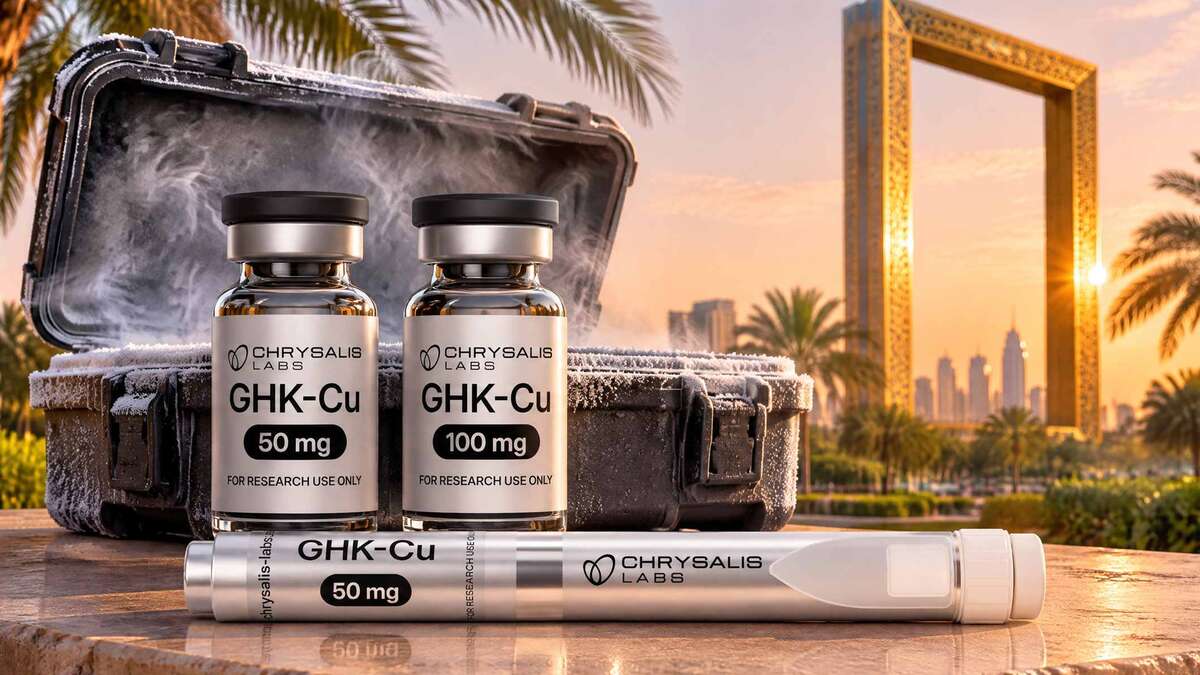
GHK-Cu sizes: 50 mg, 100 mg, vial or pen
Up to about 16 mg of every 100 mg on a GHK-Cu label is copper, not peptide. What the number holds, and how to put a 50 mg and a 100 mg unit on one price scale.
Everything on this site is supplied strictly for in-vitro laboratory research. Not for human or veterinary use.
See our Research Use Only policy (opens in a new tab)For research use only


Research areas
Strictly for in-vitro laboratory research. Not for human or veterinary use.

The short answer
BPC-157 and TB-500 are two unrelated peptides. BPC-157 is a chain of 15 amino acids, GEPPPGKPADDAGLV, at 1,419.5 g/mol; TB-500 is a product name that two 2012 lab analyses tied to Ac-LKKTETQ, a capped 7-amino-acid piece of thymosin beta-4, at 889.0 g/mol.1,2,6,7
The blend vial holds 5 mg of each: equal by weight, not by count. If its TB-500 is that fragment, there are about 8 TB-500 molecules for every 5 of BPC-157. If it is full thymosin beta-4, at 4,963 g/mol,3 there are about 3.5 BPC-157 molecules per thymosin beta-4 (our arithmetic). The mass on the batch document says which.
Strictly for in-vitro laboratory research. Not for human or veterinary use.
“Fragment” means Ac-LKKTETQ, the capped piece named in the two 2012 analyses.6,7 The mass on the batch document says which one a vial holds: about 889 for the fragment, about 4,963 for full thymosin beta-4. Chemistry from PubChem, checked ; listing as of .
A single chain of 15 amino acids in one fixed order: GEPPPGKPADDAGLV. PubChem writes it H-Gly-…-Val-OH, which means both ends are plain, with nothing attached.1
The name comes from a much bigger molecule. In 1993 a team at the University of Zagreb wrote up a protein named BPC, with a relative weight of 40,000, and a 15-amino-acid fragment of it called BPC 157.5 By weight, the fragment is about one twenty-eighth of its parent.
The letter-by-letter breakdown is in What is BPC-157? 15 amino acids, explained.
A product name, and the name alone does not fix the molecule. In 2012 a lab in Belgium analysed a product called TB-500 with high-resolution mass spectrometry. It found Ac-LKKTETQ: positions 17 to 23 of thymosin beta-4, with an acetyl cap at the start.6 A lab in Hong Kong named it the key ingredient of TB-500 that same year.7 PubChem lists “TB-500” among the names of that capped peptide, at 889.0 g/mol.2
The 2012 fragment, as written
Ac-LKKTETQ-OH
Thymosin beta-4 itself is a natural peptide of 43 amino acids, sequenced from calf thymus in 1981, at 4,963 g/mol.8,3 Its PubChem record does not list the name TB-500.3
So read “TB-500” as a question for the batch document. The seller picks the name; the mass on the document's identity line answers it: about 889 for the capped fragment, about 4,963 for the full chain. TB-500 vs thymosin beta-4: name vs molecule walks through both.
Lay them side by side, one bead per amino acid, and the gap shows at once.
Two chains, drawn to the same bead size
BPC-157 15 amino acids · 1,419.5 g/mol
TB-500 fragment 7 amino acids · 889.0 g/mol
Lit: E, K and L, the three kinds in both chains. Not one neighbouring pair is shared.
Length: 15 against 7. BPC-157 is about twice as long.
Letters: BPC-157 uses eight kinds of amino acid, the fragment five. Only three kinds turn up in both: glutamic acid, lysine and leucine.
Order: the decisive one. Of BPC-157's 14 neighbouring pairs and the fragment's 6, not one appears in both chains (our check, from the PubChem sequences).1,2 Neither chain is a piece of the other, and they trace back to two different parent molecules.
Character: BPC-157 is proline-rich, with P at positions 3, 4, 5 and 8. The fragment has no proline at all; instead it carries two lysines side by side and two threonines.
Ends: BPC-157 is plain at both ends. The fragment starts with an acetyl cap and finishes with a plain acid end: Ac-Leu-…-Gln-OH.2
It depends on the TB-500. Against the fragment, BPC-157 is about 1.6 times heavier: 1,419.5 against 889.0 g/mol.1,2 Against full thymosin beta-4 it flips: at 4,963 g/mol, thymosin beta-4 is about 3.5 times heavier than BPC-157.3
g/mol, grams per mole, is what 6.0 × 10²³ molecules of a compound weigh. The higher the number, the heavier each molecule.
Weight also decides the next question. Milligrams on a label measure weight, and a lighter molecule fits more copies into the same milligrams.
What it says: two compounds share one vial, 5 mg of each, 10 mg in all. Our label reads “BPC-157 + TB-500 · 5 mg + 5 mg”. A figure for the whole vial, such as “10 mg”, fits 5 + 5 as well as 8 + 2: the label and the report should give each amount.
What it leaves out: how many molecules of each. Divide each weight by that compound's molecular weight; the Avogadro constant turns the moles into molecules.10
Same 5 mg, different counts
With the fragment, that is about 1.6 TB-500 molecules per BPC-157 molecule, roughly 8 to 5. With the full chain, about 3.5 BPC-157 molecules per thymosin beta-4. One label, two very different ratios; the mass on the batch document says which.
µmol, a micromole, is a count of molecules: one µmol is about 6.0 × 10¹⁷ of them.
Everything a single compound needs, twice, on one sheet. Both names, and both amounts against the label: 5 mg and 5 mg.
Two identities. In electrospray mass spectrometry, molecules pick up charge from hydrogen ions and are sorted by mass divided by charge.13 With one charge, look near 1,420.5 for BPC-157 and near 890.0 for Ac-LKKTETQ, or about 1,419.7 and 889.5 on a high-resolution report. With two charges: near 710.8 and 445.5, or about 710.4 and 445.3 (our arithmetic from the PubChem masses; the figure shows how).1,2
One blend, two of everything
Two names, two amounts, two masses, two main peaks
If the TB-500 is full thymosin beta-4, its identity line looks different. A molecule that size picks up several charges at once, and the instrument's software works those readings back to one mass: about 4,963, or 4,960.5 if the report gives the monoisotopic mass.3,13
Two main peaks. On an HPLC trace, each compound in a sample shows as its own peak,11 so a two-compound vial gives two main peaks, where a single compound gives one. Where each lands depends on the lab's method.12 How HPLC works: reading the peaks walks through a trace.
Chrysalis Labs is lab-verified.
Purity and identity: two different questions · How to read a certificate of analysis
As of 17 Nov 2026, six products across the two compounds:
One blend Vial or two single Vials? The same two compounds, offered two ways:
| Fact | Blend Vial | Two single Vials |
|---|---|---|
| Inside | Both compounds in one Vial | One compound in each Vial |
| BPC-157 + TB-500 | 5 mg + 5 mg | 10 mg + 10 mg |
| On the label | Both names and both amounts | One name and one amount on each |
| The lab report should list | Both compounds and both amounts | One compound and its amount, on each report |
| Buy 2, get 1 free | Two blend Vials bring a third | Two different items: two of the same single Vial bring a third |
A Vial arrives as freeze-dried powder, a Pen as a solution: Peptide vial, pen or spray explains. Each product page shows the current price in AED.
Kept sealed: a Vial at room temperature for short periods and at −20 °C for the long term, away from light; a Pen in the fridge at 2–8 °C from the day it arrives. The reasons are in Do sealed peptide vials expire? and What is a peptide pen?
Delivery: AED 25 in every emirate, free from AED 350 of products after discounts. Dubai and Sharjah orders placed before 14:00 usually arrive the next working day; other emirates take 1–2 working days, and Al Dhafra (Western Region) 2–3. Times are estimates. Delivery zones and charges
Cash on delivery covers Vials and Pens: 5% of the product subtotal after discounts, minimum AED 20. Cash on delivery for peptides in the UAE
Buy 2, get 1 free: pay for two of the same item (same compound, same format, same amount) and the third one is free, once per order. The table above shows how that works for the blend. Buy 2, get 1 free on peptides: how it works
Listing, delivery, payment and offer as of . For researchers aged 21 and over, with a UAE address.
They are two unrelated peptides. BPC-157 is a 15-amino-acid chain, GEPPPGKPADDAGLV, at 1,419.5 g/mol. TB-500 is a product name that two 2012 lab analyses tied to Ac-LKKTETQ, a capped 7-amino-acid piece of thymosin beta-4, at 889.0 g/mol. Neither is a piece of the other: BPC-157 and that fragment come from different parent molecules and share no pair of neighbouring amino acids. The name alone does not fix the molecule: the mass on the batch document says whether a vial holds that fragment (about 889) or full thymosin beta-4 (about 4,963).
5 mg of each compound in one vial, 10 mg in all: equal by weight, not by count. 5 mg of BPC-157 is 3.52 µmol. 5 mg of TB-500 is 5.62 µmol if it is the fragment Ac-LKKTETQ, about 8 TB-500 molecules for every 5 of BPC-157. It is 1.01 µmol if it is full thymosin beta-4, about 3.5 BPC-157 molecules per thymosin beta-4. The mass on the batch document says which.
Not at Chrysalis Labs: our blend holds 10 mg in all, labelled 5 mg + 5 mg. On any blend, a figure for the whole vial fits 5 + 5 as well as 8 + 2, so the label and the lab report should each give both amounts.
It depends on the TB-500. Against the fragment Ac-LKKTETQ (889.0 g/mol), BPC-157 (1,419.5 g/mol) is about 1.6 times heavier. Against full thymosin beta-4 it flips: at 4,963 g/mol, thymosin beta-4 is about 3.5 times heavier than BPC-157.
By mass. With one charge on an electrospray mass spec, BPC-157 sits near 1,420.5, or about 1,419.7 on a high-resolution instrument. A TB-500 that is the fragment Ac-LKKTETQ sits near 890.0, or about 889.5. Full thymosin beta-4 picks up several charges at once, and the software works them back to one mass of about 4,963. An HPLC trace of the blend shows two main peaks, one per compound.
Chrysalis Labs, a lab-verified UAE online store for researchers aged 21 and over, lists BPC-157 + TB-500 as a 5 mg + 5 mg Vial and Pen (as of 17 Nov 2026). Each product page shows the current price in AED. It delivers to all seven emirates: AED 25, free from AED 350. Cash on delivery covers both, for 5% of the product subtotal after discounts, minimum AED 20. Strictly for in-vitro laboratory research. Not for human or veterinary use.
Our own pages: Delivery zones and charges · the catalogue
Listed as a 5 mg + 5 mg Vial and Pen, next to BPC-157 and TB-500 on their own. Chrysalis Labs is lab-verified and delivers to all seven emirates. Cash on delivery on Vials and Pens, as of .
Strictly for in-vitro laboratory research. Not for human or veterinary use.
Chrysalis Labs Research Team · Sources checked
Up to about 16 mg of every 100 mg on a GHK-Cu label is copper, not peptide. What the number holds, and how to put a 50 mg and a 100 mg unit on one price scale.
Catalogues often use the two names as one. The molecules behind them differ by 36 amino acids and more than 4,000 g/mol.
On a mass spec, PT-141 lands just 0.02 from a peak of its near-twin, Melanotan II. Seven amino acids, a 23-atom ring, and how to tell which one a report shows.