

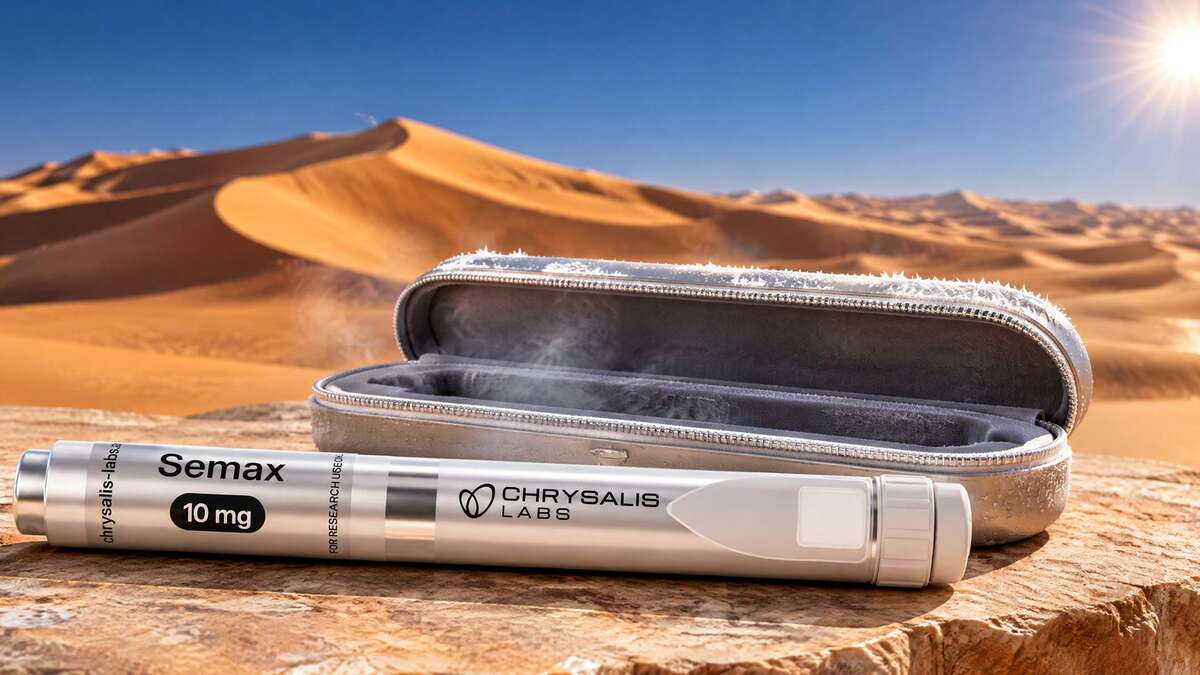
Storing peptide pens in UAE heat
A pen holds its peptide already dissolved, so heat matters more than it does for powder. Here is what UAE summers mean for a pen, from the doorstep to the fridge shelf.
Everything on this site is supplied strictly for in-vitro laboratory research. Not for human or veterinary use.
See our Research Use Only policy (opens in a new tab)For research use only


Research areas
Strictly for in-vitro laboratory research. Not for human or veterinary use.

No vial goes bad at midnight on a printed date. A dry peptide keeps changing slowly, and you can name what sets the speed.
The short answer
Yes, slowly: a sealed vial of freeze-dried peptide keeps changing chemically even when it is dry and frozen, but there is no day on which it suddenly goes bad.2
How fast it changes depends on the peptide’s own sequence, the water in the powder, the temperature and the light, so a real expiry or re-test date belongs to one batch in one kind of vial, never to “peptides” in general.1
Strictly for in-vitro laboratory research. Not for human or veterinary use.
Dates and terms from the ICH stability guideline;1 glass transition from Hancock and Zografi;5 facts checked .
A proper date on a vial is a forecast backed by data. The international stability guideline, ICH Q1A(R2), uses two kinds of date.1
| Question | Expiry date | Re-test date |
|---|---|---|
| Used on | The label of a finished product | A batch of raw substance |
| What it says | The batch should stay within its specification until then, if stored as the label says | The batch can be used until then, if stored as defined |
| After the date | Not used | Tested again; if it passes, used straight away. Can be re-tested more than once |
| Built from | Real-time data at the label’s storage condition, plus a hotter “accelerated” test | |
| Freezer storage | Real-time data at −20 °C only, plus a warmer test for short trips out of the freezer | |
Both come from the same work: samples of a batch kept in controlled rooms and normally tested every 3 months in year one, every 6 months in year two, then yearly. For room-temperature products, a hotter room runs alongside: 40 °C at 75% humidity for 6 months, to make change happen faster on purpose.1
How a stability date is earned
A date marks where the evidence ends. Nothing happens to the vial at midnight, and the date says little about a vial kept somewhere the data never covered. For frozen storage there is no shortcut: the date has to come from real time spent at −20 °C.1
Freeze-drying takes the water out. Peptide and protein products are often made solid to keep them stable in storage.2
Dry slows the chemistry down, but some of it keeps going. A 1999 review lists six reactions that can still run in the solid state, among them deamidation (an amide group turning into an acid), breaks in the peptide bond and oxidation. Temperature and moisture content help set their pace.2
Freeze-dried peptide powder: how it looks shows what a normal cake looks like.
From the stopper. Rubber holds water, and a dry cake pulls it in.
In a 1992 study, freeze-dried test materials under 13 mm rubber stoppers gained water until they reached a balance with the stopper. The water came out of the stopper itself; none was found passing through it from outside.3
Heat set the speed: getting half-way to that balance took about 10 months at 5 °C and about 4 days at 40 °C.3 By our arithmetic, that is roughly 75 times faster. The final amount of water did not depend on the temperature.3
Time for stopper water to get half-way into a dry cake
Smaller amounts of product ended up wetter,3 and a 10 mg research vial holds very little. Stoppers differ too: a later study found one commercial type held about seven times more water than another.4
Why a little water matters: water often softens glassy solids. The glass transition temperature drops fastest with the first water a dry solid takes up, and it can strongly affect chemical stability.5 Damp and heat work as a team.
Because reaction speed climbs faster than the thermometer. Our guide to storing research peptides in UAE heat covers the rough 10 °C rule; stability science adds a sharper idea, mean kinetic temperature.
It is the single temperature that gives the same heat stress as a real run of hotter and cooler spells, and it is always higher than the plain average.1 A night in the fridge doesn’t cancel an afternoon in a parked car.
The guideline also asks for data on short trips outside the label’s conditions, such as shipping.1 In UAE heat, the trip home is the risky part.
Light matters too: it can trigger oxidation,6 and a closed box keeps it out.
Because each chain carries its own weak spots, two vials in the same freezer can change at different speeds.
Two kinds of weak spot are easy to find in a sequence. First, five amino acids are the most open to oxidation: methionine (M), cysteine (C), histidine (H), tryptophan (W) and tyrosine (Y).6
Second, asparagine (N) or aspartate (D) followed by glycine (G) can close into a small ring that leads to breakdown. In a 1987 study of peptides in solution, a bulkier neighbour in glycine’s place slowed the breakdown 33 to 50 times.7
Four sequences from our vial shelf, marked that way:
Weak spots on four sequences
Epithalon 1 marked pair
Semax 2 marked letters
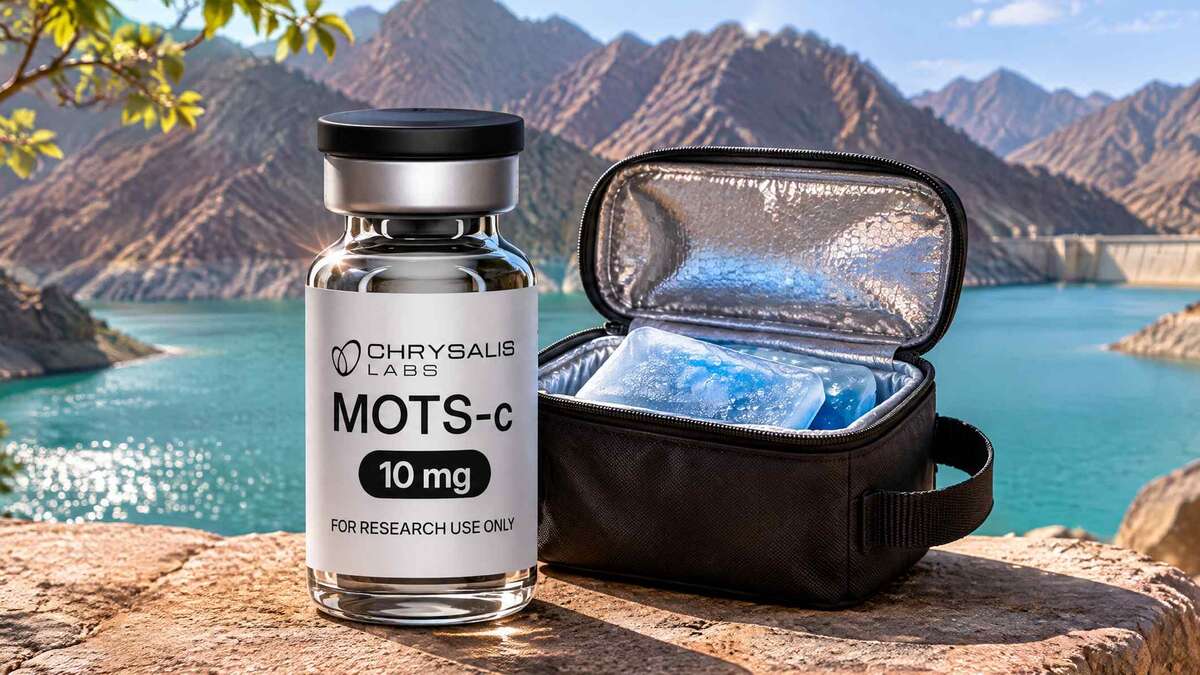
MOTS-c 5 marked letters
BPC-157 none from either list
Marked: M, C, H, W or Y, and D or N followed by G
A mark only tells you where to look. Epithalon’s D–G is the milder form of the ring reaction: in the same study, aspartate formed the ring 34 times more slowly than asparagine.7 And BPC-157’s zero applies to these two lists only; breaks in the peptide bond are on the 1999 list too.2
The four vials: Epithalon, Semax, MOTS-c and BPC-157. New to letter codes? How to read a peptide sequence explains them. Two spellings, one peptide: Epithalon or Epitalon?
Mostly no. Oxidation usually adds one oxygen atom, and deamidation swaps one small group for another. Changes that small don’t show in the powder, so a perfect white cake can hold a changed peptide.
Seeing it takes a method that separates a sample into its parts, so a breakdown product shows up beside the main compound. HPLC is the usual one; How HPLC works: reading the peaks walks through a trace.
Your eyes can check the outside: seal, glass, label and a dry cake (the arrival checklist is in our storage guide).
What your eyes can and can’t check
4 of 6 you can check by eye
Read the vial first: its label and product page are the first word on storage. Our guidance for sealed peptide vials:
“Lyophilized peptides are stable at room temperature for short periods. For long-term storage, keep sealed vials at −20 °C, away from light.”
Buying ahead is easy: Buy 2, get 1 free covers our peptide vials. Pay for two of the same vial and the third is free, once per order. The third one waits longest, so it goes straight into the freezer.
Short trips help too: Dubai and Sharjah orders placed before 14:00 usually arrive the next working day, other emirates in 1–2 working days and Al Dhafra in 2–3. Times are estimates.
Offer and delivery times as of .
All vials · Delivery zones and charges
What this guide doesn’t cover: opened vials, instructions for use and effects of any kind. Strictly for in-vitro laboratory research. Not for human or veterinary use.
Yes, slowly. Dry powder keeps better than a solution, but oxidation and deamidation can still run in the dry state.
No single number fits every peptide: sequence, water, temperature and light all change it. Follow the vial’s label and product page. Our guidance for sealed peptide vials is −20 °C for the long term, away from light.
Up to an expiry date, a batch should stay within its specification; after it, it isn’t used. After a re-test date, a batch is tested again and used only if it passes. Both assume the stated storage.
No. Cold slows the reactions down but doesn’t stop them. For a freezer date, the ICH stability guideline accepts only real-time data at −20 °C.
Yes, from its own rubber stopper. In a 1992 study, dry cakes took up water from the stopper; getting half-way to balance took about 10 months at 5 °C and about 4 days at 40 °C.
Not reliably. Oxidation and deamidation usually don’t show in the powder; a separating lab method such as HPLC is needed to see them.
Our own pages: Vials · Delivery zones and charges
All seven emirates. Cash on delivery on vials and pens.
Strictly for in-vitro laboratory research. Not for human or veterinary use.
Chrysalis Labs Research Team · Facts checked
A pen holds its peptide already dissolved, so heat matters more than it does for powder. Here is what UAE summers mean for a pen, from the doorstep to the fridge shelf.
A solid puck, a cracked one, loose crumbs, a faint film, even blue. What each look tells you, and the few worth a message.
About 90 mg of benzyl alcohol per 10 mL vial is what sets the two apart. And “0.9%” on a label can mean that preservative or plain salt.