

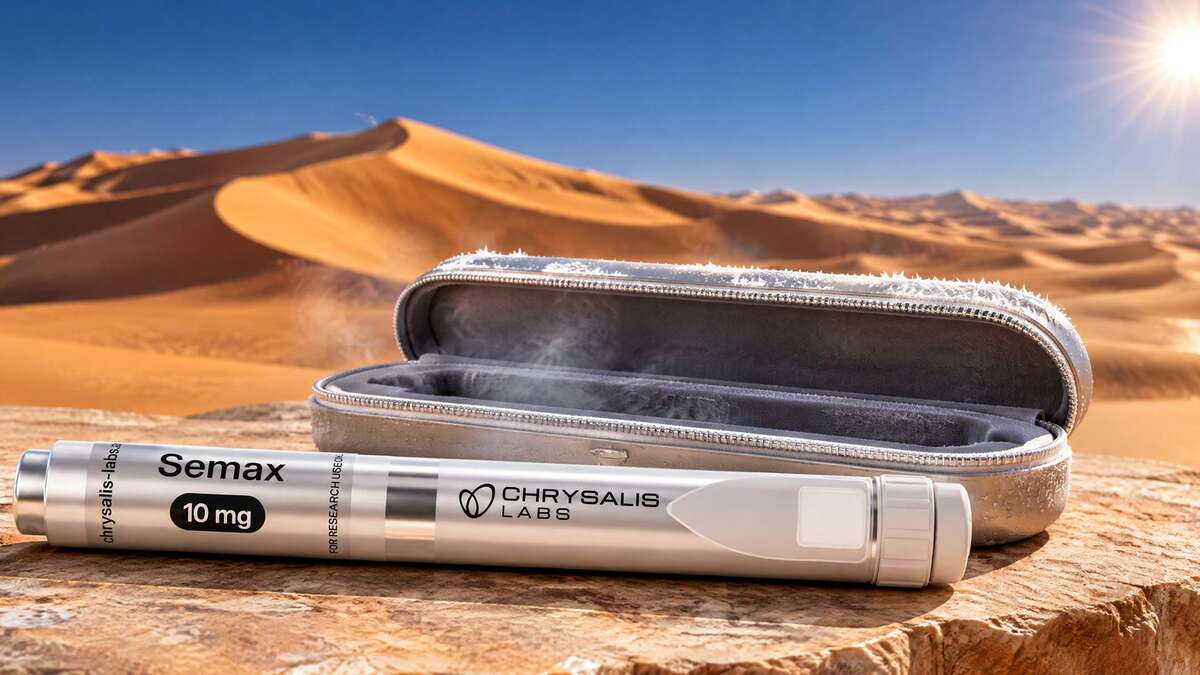
Storing peptide pens in UAE heat
A pen holds its peptide already dissolved, so heat matters more than it does for powder. Here is what UAE summers mean for a pen, from the doorstep to the fridge shelf.
Everything on this site is supplied strictly for in-vitro laboratory research. Not for human or veterinary use.
See our Research Use Only policy (opens in a new tab)For research use only


Research areas
Strictly for in-vitro laboratory research. Not for human or veterinary use.
Heat, light and damp slowly break peptides down, and a UAE summer is hard on any parcel. These guides show where a sealed vial, a pen, a spray or a bottle of bacteriostatic water belongs: freezer, fridge or shelf, and for how long. They explain what a freeze-dried powder is and what to check the day a delivery arrives. Every number comes with its source.
A pen holds its peptide already dissolved, so heat matters more than it does for powder. Here is what UAE summers mean for a pen, from the doorstep to the fridge shelf.
A solid puck, a cracked one, loose crumbs, a faint film, even blue. What each look tells you, and the few worth a message.
No vial goes bad at midnight on a printed date. A dry peptide keeps changing slowly, and you can name what sets the speed.
Try a compound name, such as GHK-Cu.
Sealed, dry and dark. A freeze-dried powder is fine at room temperature for short periods and goes in a freezer at −20 °C for the long term.
In the fridge at 2 to 8 °C, the day it arrives. A pen holds a liquid, and a liquid keeps less well than a dry powder.
That every cap and seal is intact, the glass is whole, and the name and amount match your order. Then store each item where it belongs, the same day.