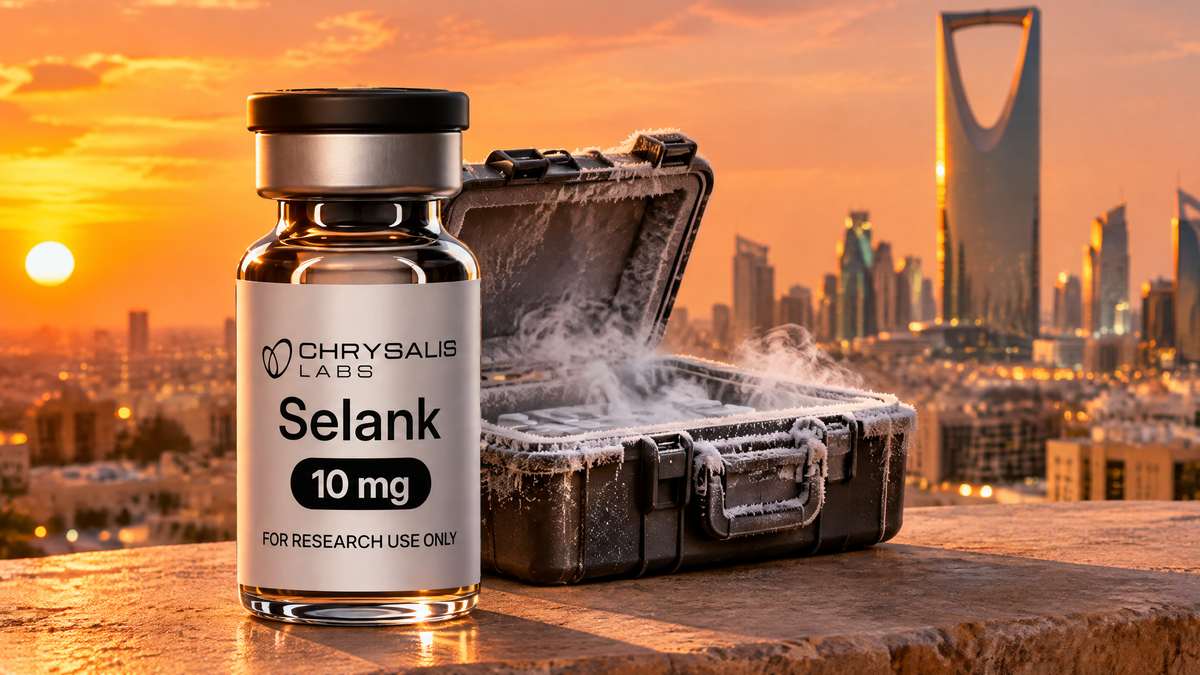


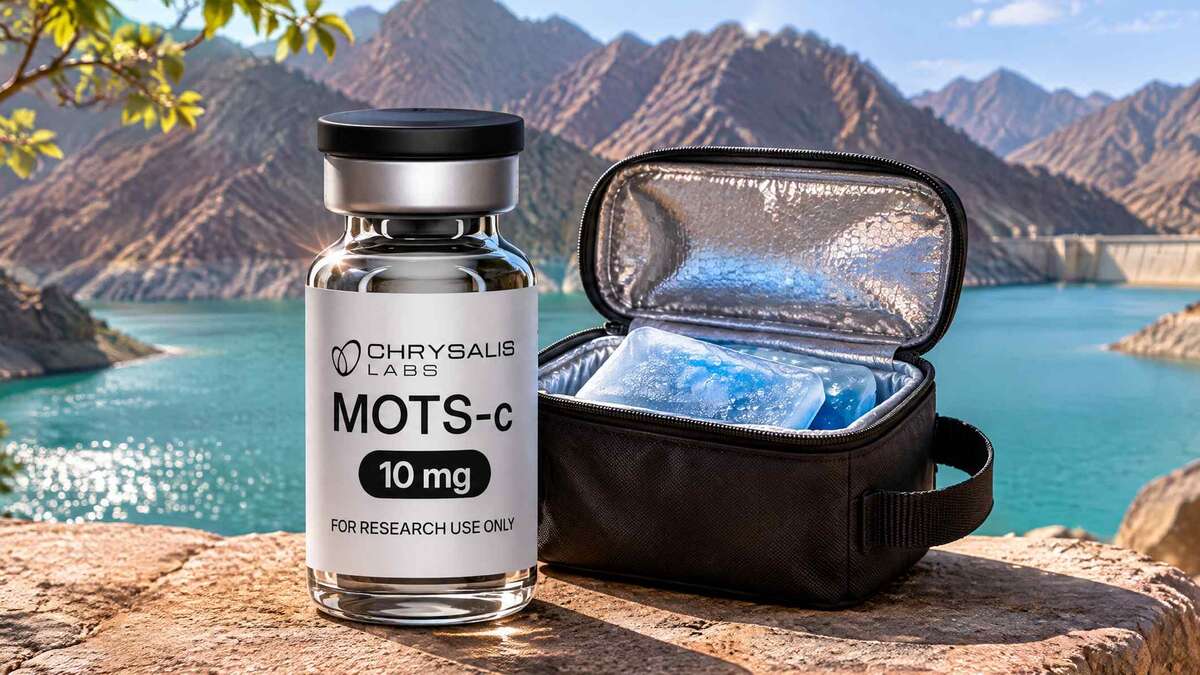
Freeze-dried peptide powder: how it looks
A solid puck, a cracked one, loose crumbs, a faint film, even blue. What each look tells you, and the few worth a message.
Everything on this site is supplied strictly for in-vitro laboratory research. Not for human or veterinary use.
See our Research Use Only policy (opens in a new tab)For research use only


Research areas
Strictly for in-vitro laboratory research. Not for human or veterinary use.

A pen holds its peptide already dissolved, so heat matters more than it does for powder. Here is what UAE summers mean for a pen, from the doorstep to the fridge shelf.
The short answer
Peptide pens need the fridge at 2–8 °C from the day they arrive, because a pen holds its compound already dissolved. Keep it on a main shelf, not in the door, and never in the freezer.
In the UAE the risk is the trip to the fridge. Even Dubai's average January low is 13.7 °C,3 and in Arizona summer tests in 2014, closed cars in the sun averaged 46.7 °C inside after about an hour.4
Strictly for in-vitro laboratory research. Not for human or veterinary use.
Fridge line: our guidance for pens. Air: WMO 1974–1991 averages of Dubai's daily high. Cars: Arizona summer tests in 2014, 32.8–41.5 °C outside. Checked .
Yes, and the reason is inside the pen. A peptide pen like ours comes pre-filled, with the compound already in solution in a sealed cartridge; a Vial carries it as a dry, freeze-dried powder. That one difference decides where each of them lives.
Peptides are often unstable in water-based solutions: the chain can break or react, and heating, freezing or shaking can make chains clump together.5 Dry powder is the more forgiving state, so our guidance gives the two formats different lines.
For pens it is a single line: Pens are kept at 2–8 °C. It holds for every pen we list, from the 10 mg BPC-157 Pen to the 500 mg NAD+ Pen. A sealed Vial gets more slack: room temperature for short periods, −20 °C for the long term. More in Do sealed peptide vials expire?
Even the open air is far outside a pen's line. Dubai's average afternoon high is 40.6 °C in July and still 30.5 °C in November.3 Both are above the 20–25 °C a pharmacopoeia calls controlled room temperature,2 let alone a pen's 2–8 °C. Nights stay above a pen's line too: the average daily low runs from 13.7 °C in January, the coolest month, to 29.3 °C in August.3
Dubai's average daily low, month by month
The air is only the start, because closed spaces trap the sun. In Arizona summer tests in 2014, with 32.8 to 41.5 °C outside, closed cars in the sun averaged 46.7 °C inside after about an hour, and their dashboards 68.9 °C. Shade helped less than you would hope: shaded cars still averaged 38.3 °C.4
Winter doesn't fix a parked car. A study of a dark car on clear days found the cabin warming by almost 2 °C every five minutes on average, with about 80% of the rise inside the first 30 minutes.6
On the study's coolest day, 22 °C outside, below Dubai's average January high of 24.0 °C,3 the cabin still reached 47 °C within the hour. On two of the days the windows were also left open about 4 cm, and neither the warming rate nor the peak came down.6
One hour in a closed car, on a 22 °C day
We give no allowance in hours, because each compound changes at its own pace. On your side, keep its time out of the fridge short: into the fridge as soon as it arrives.
Warmth is why the trip should be short. Chemistry has a rough rule: each 10 °C rise about doubles a reaction's speed. It does not hold for every reaction.7 Start from a 5 °C fridge and run the numbers (our arithmetic, rounded):
How fast the slow chemistry runs, next to a 5 °C fridge
By that rule, an hour at 46.7 °C moves the slow chemistry about as far as 18 hours in a 5 °C fridge. It shows scale only: real rates differ from compound to compound.
On a main shelf, not in the door. In a study of 25 home fridges, the door compartment averaged 5.1 °C against 3.4 °C in the inner storage box, and only the door showed a clear difference from top to bottom. The authors' advice: keep temperature-sensitive foods out of the door.1
Then check the fridge itself, because many home fridges run warm. In one survey of 119 fridges, the average was 6.6 °C and one in four ran above 8 °C, the top of a pen's line.8 Studies worldwide show the same pattern, little changed in about 40 years.9 A cheap fridge thermometer on the pen's shelf settles it in a day.
Inside 25 home fridges, cold to warm
Keep the cap on, too. Light can damage some amino acids,10 and with the cap in place, the cartridge sits in the dark. A pen case or a fridge holder keeps pens tidy but does not cool them, and a mini fridge counts only if a thermometer inside it reads 2–8 °C. More on the cap in What is a peptide pen?
CURECELL Bacteriostatic Water shares the shelf: its label says 2–8 °C, away from heat and light. More in Bacteriostatic water vs sterile water.
No. A pen's line is the fridge, 2–8 °C. The −20 °C line in our guidance is for sealed Vials of dry powder, which have no liquid to turn to ice. In solution, freezing is one of the named stresses that can make peptide chains clump.5
Delivery day is where a pen meets UAE heat, so plan it. Our side first, as of .
From our shelf to your fridge
Order before 14:00 for the next working day in Dubai and Sharjah
Other emirates usually take 1–2 working days, Al Dhafra (Western Region) 2–3; working days run Monday to Saturday, excluding UAE public holidays. You can track the order on the way.
Chrysalis Labs is lab-verified and sells to researchers aged 21 and over in all seven emirates. As of 17 Nov 2026: delivery AED 25, free from AED 350 of products after discounts; cash on delivery on Pens, 5% fee, minimum AED 20; Buy 2, get 1 free on two of the same pen (same compound, same amount), once per order.
Yes. A pen holds its compound already dissolved, and the Chrysalis Labs line for every pen is the fridge, 2–8 °C, from the day it arrives. A sealed Vial of dry powder is more forgiving. Strictly for in-vitro laboratory research. Not for human or veterinary use.
In the fridge at 2–8 °C from the day they arrive: on a main shelf, not in the door, and never in the freezer. Keep them out of parked cars, even in winter. A case or holder keeps pens tidy but does not cool them; a mini fridge counts only if a thermometer inside it reads 2–8 °C.
2–8 °C, the line for every pen we list. Many home fridges run warm: in one survey, one in four ran above 8 °C, so a thermometer on the pen's shelf helps.
No. In Arizona summer tests in 2014, closed cars averaged 46.7 °C inside after about an hour in the sun, and 38.3 °C in the shade. Winter doesn't fix a parked car either: on a 22 °C day, a dark car in another study still reached 47 °C within the hour.
We give no allowance in hours, because each compound changes at its own pace. On your side, keep its time out of the fridge short: into the fridge as soon as it arrives.
No. A pen's line is the fridge, 2–8 °C. The −20 °C line in our guidance is for sealed Vials of dry powder; in solution, freezing can make peptide chains clump.
No. In January, Dubai's coolest month, the average high is still 24.0 °C and even the average low is 13.7 °C, both above a pen's 2–8 °C.
Be there to take it in. The pen should be intact, with nothing leaking, and its label should name the compound and amount you ordered; then it goes on a main fridge shelf within minutes. If it is damaged or not what you ordered, photograph the pen and the parcel, then message us promptly with your order number.
Our own pages: Pens · Delivery zones and charges · Track order · FAQ
Delivered across all seven emirates. Cash on delivery on Vials and Pens.
Strictly for in-vitro laboratory research. Not for human or veterinary use.
Chrysalis Labs Research Team · Facts checked
A solid puck, a cracked one, loose crumbs, a faint film, even blue. What each look tells you, and the few worth a message.
No vial goes bad at midnight on a printed date. A dry peptide keeps changing slowly, and you can name what sets the speed.
About 90 mg of benzyl alcohol per 10 mL vial is what sets the two apart. And “0.9%” on a label can mean that preservative or plain salt.