

Storage & handling
Freeze-dried peptide powder: how it looks
A solid puck, a cracked one, loose crumbs, a faint film, even blue. What each look tells you, and the few worth a message.
Everything on this site is supplied strictly for in-vitro laboratory research. Not for human or veterinary use.
See our Research Use Only policy (opens in a new tab)For research use only


Research areas
Strictly for in-vitro laboratory research. Not for human or veterinary use.

About 90 mg of benzyl alcohol per 10 mL vial is what sets the two apart. And “0.9%” on a label can mean that preservative or plain salt.
The short answer
Bacteriostatic water is sterile water with a small amount of preservative added: on the CURECELL vial we stock, 0.9% benzyl alcohol. Sterile water is the same water with nothing added. The preservative slows the growth of bacteria that get in once a vial has been opened, so bacteriostatic water suits more than one opening and sterile water a single one.
Facts checked on
| Fact | Bacteriostatic water | Sterile water |
|---|---|---|
| What it is | Sterile water plus a preservative1 | Sterile water, nothing added2 |
| Added ingredient | Benzyl alcohol, 0.9%: 9 mg in each mL, on the CURECELL label | None2 |
| Once opened | The preservative holds back bacteria that get in4 | Nothing holds bacteria back |
| Suits | More than one opening | A single opening |
| At Chrysalis Labs | CURECELL Bacteriostatic Water, 10 mL vial. Its label: fridge, 2–8 °C | Not in our catalogue |
Bacteriostatic water, often shortened to bac water, starts as sterile water. The pharmacopoeia, a published book of standards, describes it as that water with one or more antimicrobial agents added.1
On the CURECELL label, the agent is benzyl alcohol, added as a preservative at 0.9%: 9 mg in each mL. Benzyl alcohol is a small molecule: formula C7H8O, weight 108.14 g/mol.3
“Bacteriostatic” says what it does. In microbiology, a “-static” method stops bacteria from growing without killing them.4 So the preservative works like a brake on bacteria.
Sterile water is the same starting water, sterilised and sealed, with nothing else in it: no preservative and no other added substance.2
With no preservative, nothing holds microbes back once the seal is broken. So it suits a single opening.
About 90 mg. At 0.9%, each mL carries 9 mg of benzyl alcohol (the CURECELL label prints both figures), and 10 mL makes 90 mg. The rest is water.
Counted in molecules, the share is smaller still. From the published weights of the two molecules,2,3 there are roughly 660 water molecules for every one of benzyl alcohol. That is our own arithmetic, rounded.
No. Only the number is the same. 0.9% saline is a salt solution: 9.0 g of sodium chloride per litre of water, which is 9 mg in each mL.5 In bacteriostatic water the 0.9% is benzyl alcohol, and there is no salt at all.
So “0.9%” alone doesn't tell you what is in a vial. Read the full name and the ingredient line. On the CURECELL vial they read bacteriostatic water and benzyl alcohol 0.9% (9 mg/mL), and the composition line lists only benzyl alcohol and water.
How often the vial is opened. Protein products made to be opened many times need a preservative,8 and benzyl alcohol is one of the two used most often in peptide and protein products.6
The preservative itself. It is one more ingredient in the vial. In one lab study, a freeze-dried test protein clumped more when 0.9% benzyl alcohol was in the water than with plain water.7 That was one protein, not a short peptide, so it may not hold for other molecules. A lab that wants nothing extra can pick sterile water and accept the single opening.
The choice belongs to the lab's written procedure and the compound's data sheet. This guide gives no mixing steps, amounts or timings.
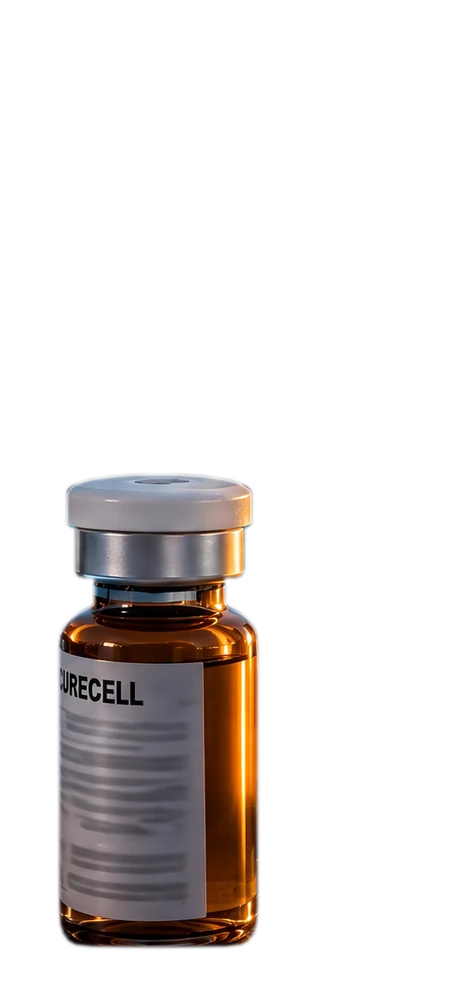
Here are seven parts of the label on the CURECELL vial we stock.
Follow the storage line on the vial in your hand. The CURECELL label says to keep the vial in a refrigerator at 2–8 °C, away from heat and light.
In the UAE: be there to receive the parcel, put the vial in the fridge the day it arrives, and check its beyond-use date. If anything looks wrong, message us with a photo.
At Chrysalis Labs: CURECELL bacteriostatic water, supplied in its original CURECELL packaging. Each vial contains 10 mL. The product page shows the current price per single vial and whether it is in stock.
Delivery is the same for every order:
The water is sold on its own: it doesn't come with a peptide vial, and it is not part of Buy 2, get 1 free or the volume discount.
Bacteriostatic water is sterile water with a preservative added: 0.9% benzyl alcohol on the CURECELL label. Sterile water has nothing added. The preserved one suits more than one opening, the plain one a single opening.
Bac water is short for bacteriostatic water: sterile water with a small amount of preservative. On the CURECELL label, that is 0.9% benzyl alcohol.
About 90 mg. At 0.9% there are 9 mg in each mL, and the rest is water.
No. 0.9% saline holds sodium chloride, which is salt. Bacteriostatic water holds 0.9% benzyl alcohol, a preservative, and no salt.
As the label on the vial says. The CURECELL label says to keep it in a refrigerator at 2–8 °C, away from heat and light.
Chrysalis Labs sells CURECELL bacteriostatic water as a 10 mL vial and delivers to all seven emirates. The product page shows the current price and stock.
CURECELL, 10 mL vial, in its original packaging. Delivered to all seven emirates.
View bacteriostatic water or ask on WhatsApp.
Strictly for in-vitro laboratory research. Not for human or veterinary use.
A solid puck, a cracked one, loose crumbs, a faint film, even blue. What each look tells you, and the few worth a message.
No vial goes bad at midnight on a printed date. A dry peptide keeps changing slowly, and you can name what sets the speed.
Learn 20 letters and which end comes first, and MEHFPGP reads like a word.