

What is a peptide pen? A plain guide
Four parts, one sealed solution, and a number on the label that tells you less than it seems to.
Everything on this site is supplied strictly for in-vitro laboratory research. Not for human or veterinary use.
See our Research Use Only policy (opens in a new tab)For research use only


Research areas
Strictly for in-vitro laboratory research. Not for human or veterinary use.

Learn 20 letters and which end comes first, and MEHFPGP reads like a word.
The short answer
A peptide sequence lists a peptide’s amino acids in order, from the N-terminus (the free amino end, written on the left) to the C-terminus (the free acid end, on the right).3
Each amino acid is one capital letter, as in MEHFPGP, or a three-letter code joined by hyphens, as in Met-Glu-His-Phe-Pro-Gly-Pro; both spell Semax, a chain of seven.5 Marks such as Ac-, D-, cyclo and -NH2 show where the plain chain was changed.14
Strictly for in-vitro laboratory research. Not for human or veterinary use.
Codes and marks from the IUPAC-IUB recommendations;3 sequences from PubChem and UniProt; facts checked .
A peptide is a chain of amino acids. Peptide bonds join the links, and every bond releases one molecule of water as it forms.1 The sequence is the order of the links, and that order, with the length, decides the chain’s shape and size.1
The numbers grow fast. With 20 common amino acids to pick from,1 a chain of seven can be built 207 ways: 1.28 billion different peptides. Semax is one of them. For a 16-link chain like MOTS-c, the count runs to 21 digits.
Even three different amino acids can be joined in six orders, each its own peptide.2
Each common amino acid has a three-letter code, usually the first three letters of its name,4 and a one-letter code, approved in 1968 on proposals from a subcommittee that included M. O. Dayhoff, an early compiler of protein sequences.3
Six letters are plain initials. Where several names shared an initial, the most common, simplest amino acid got it: threonine kept T, so tryptophan and tyrosine needed other letters.3
| Letter · amino acid (code) | Why this letter |
|---|---|
| A · Alanine (Ala) | Initial, over Arg, Asn, Asp |
| C · Cysteine (Cys) | Initial |
| D · Aspartic acid (Asp) | Paired with E |
| E · Glutamic acid (Glu) | Paired with D |
| F · Phenylalanine (Phe) | Sound: “Fenylalanine” |
| G · Glycine (Gly) | Initial, over Gln, Glu |
| H · Histidine (His) | Initial |
| I · Isoleucine (Ile) | Initial |
| K · Lysine (Lys) | Left over, close to L |
| L · Leucine (Leu) | Initial, over Lys |
| M · Methionine (Met) | Initial |
| N · Asparagine (Asn) | Paired with Q |
| P · Proline (Pro) | Initial, over Phe |
| Q · Glutamine (Gln) | Paired with N |
| R · Arginine (Arg) | Sound: “aRginine” |
| S · Serine (Ser) | Initial |
| T · Threonine (Thr) | Initial, over Trp, Tyr |
| V · Valine (Val) | Initial |
| W · Tryptophan (Trp) | Bulky letter, double ring |
| Y · Tyrosine (Tyr) | Left over, close to T |
IUPAC’s list adds four more letters. U is selenocysteine. B means D or N, and Z means E or Q, when the pair has not been told apart. X means unknown or atypical.3
J and O were skipped on purpose in 1968: J is missing from several languages, and O looked too much like G, Q, C, D and zero on imperfect printouts.3
Watch one overlap: A, C, G and T are also DNA letters, so CAT reads as three DNA bases or as Cys-Ala-Thr. IUPAC asks for extra care when both codes share a page.3
The N-terminus, on the left. The first letter is the amino acid with the free amino group; the last is the one with the free carboxyl group.3,2 Read backwards, a sequence names another molecule: KPV is Lys-Pro-Val, while VPK would be Val-Pro-Lys.
Some records spell the ends out, as in H-Met-Glu-His-Phe-Pro-Gly-Pro-OH for Semax.5 A hyphen on the right of a three-letter symbol removes OH from the acid group, and one on the left removes H from the amino group.4 Writing H- and -OH back says both ends are free.
A twist: chemists build the chain backwards. In solid-phase synthesis the C-terminal amino acid goes onto the resin first and the chain grows toward the N-terminus,7 yet the sequence is still written N to C.
Take MOTS-c, which UniProt lists as MRWQEMGYIFYPRKLR,8 and read it against the table.
MOTS-c, one letter at a time
16 amino acids · 3 R · 2 M · 2 Y
The three R, places 2, 13 and 16
Sixteen letters, sixteen amino acids, matching the “16-amino-acid” line on our MOTS-c Vial page. Count repeats and the chain gets a profile: three R, two M, two Y, and one each of nine others.
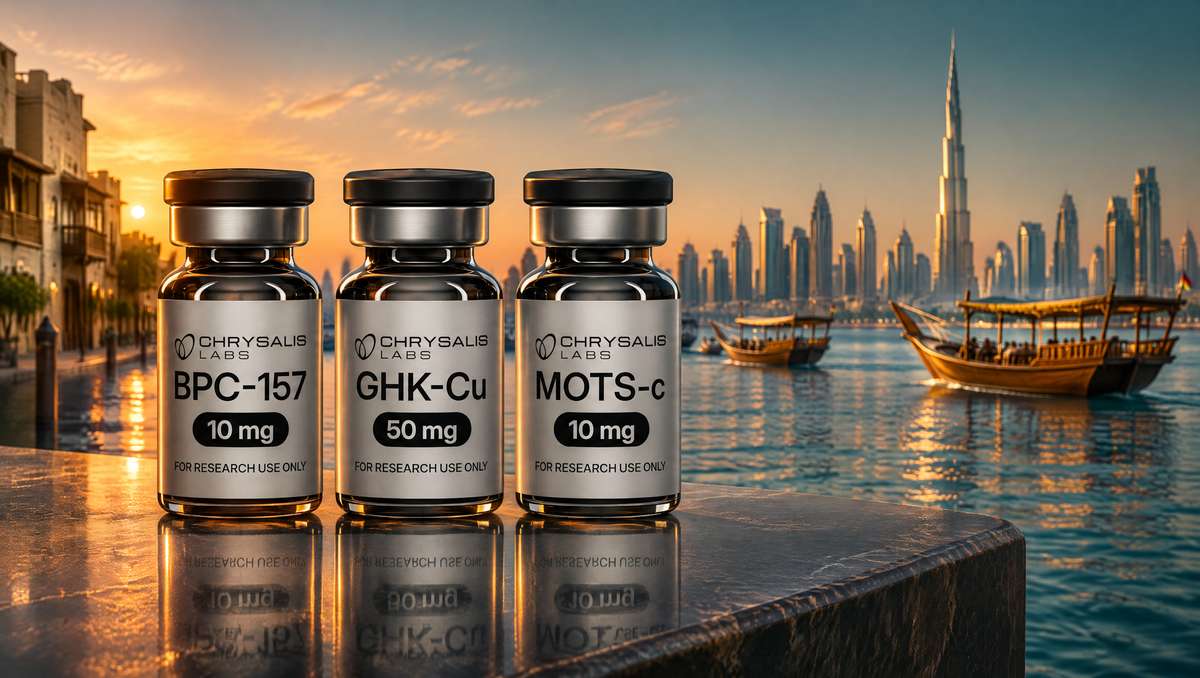
BPC-157 reads the same way: GEPPPGKPADDAGLV, 15 letters, four of them P (proline) and three G (glycine).6 More in What is BPC-157? 15 amino acids, explained.
| Compound | Sequence | Length | What to notice |
|---|---|---|---|
| KPV | KPV | 3 | The name is the sequence10 |
| GHK-Cu | GHK + copper | 3 | The name is the sequence, plus Cu |
| AHK-Cu | AHK + copper | 3 | One letter away from GHK |
| Epithalon | AEDG | 4 | Written Ala-Glu-Asp-Gly on its page9 |
| Semax | MEHFPGP | 7 | ACTH 4–7, then PGP5 |
| BPC-157 | GEPPPGKPADDAGLV | 15 | Four P, three G |
| MOTS-c | MRWQEMGYIFYPRKLR | 16 | Three R |
Three quick checks on any sequence:
Positions, counted from the N-terminus. They appear when a peptide is a piece of a longer chain.
Alpha-MSH is a hormone of 13 amino acids, SYSMEHFRWGKPV, with an acetyl cap on the first S and an amide on the last V.11,13 ACTH, 39 amino acids long, starts with the same 13.11 Two of our compounds read straight off that line.
Two pieces of one 13-letter chain
13 amino acids, numbered from the N-terminus
Semax: places 4 to 7, then PGP · KPV: places 11 to 13
Numbers inside a name mark swaps. PubChem also files Melanotan II as Acetyl-(Nle4,Asp5,D-Phe7,Lys10)-cyclo-alpha-MSH (4-10) amide:12 positions 4 to 10, with Nle at 4, Asp at 5, D-Phe at 7 and Lys at 10, closed into a ring and capped at both ends. Its 1989 design paper used the same shorthand.13
They mark changes to a plain chain,14 and Melanotan II carries all four: Ac-Nle-cyclo[Asp-His-D-Phe-Arg-Trp-Lys]-NH2.12
Melanotan II, as written
Ac-Nle-cyclo[Asp-His-D-Phe-Arg-Trp-Lys]-NH2
PubChem also calls it a cyclic (2-7) peptide: position numbers again, for the two amino acids the ring links.12,13 One more rule: glycine never carries D or L, because it has no mirror form.16
One mark makes another compound: PT-141 has the same seven amino acids and ring, and ends in -OH instead of -NH2.12,15 See Melanotan II vs PT-141: one ring, two ends.
A footnote: IUPAC’s 1983 rules asked chemists to retire the name norleucine and the symbol Nle, in favour of names built on 2-aminohexanoic acid.4 PubChem lists PT-141 under both styles.15
Not every suffix is an amino acid: the -Cu in GHK-Cu and AHK-Cu is copper, held by a three-amino-acid chain. See GHK-Cu vs AHK-Cu: one amino acid apart.
Some names hide the sequence completely. BPC-157 and TB-500 are code names; only the sequence says which molecule a name stands for. See TB-500 vs thymosin beta-4: name vs molecule.
This guide explains how sequences are written. It doesn’t cover instructions for use or effects of any kind. Strictly for in-vitro laboratory research. Not for human or veterinary use.
One capital letter per common amino acid: A alanine, C cysteine, D aspartic acid, E glutamic acid, F phenylalanine, G glycine, H histidine, I isoleucine, K lysine, L leucine, M methionine, N asparagine, P proline, Q glutamine, R arginine, S serine, T threonine, V valine, W tryptophan, Y tyrosine.
The N-terminus, the end with the free amino group, on the left. The C-terminus, with the free acid group, goes on the right.
Leucine had L. Shared initials went to the more common, simpler amino acid, and lysine took K, a free letter close to L.
The mirror-image form of that amino acid, as in D-Phe. No prefix means the L form. Glycine has no mirror form at all.
Ac- is an acetyl cap on the N-terminus; -NH2 is an amide in place of the free acid at the C-terminus. Both are part of the molecule, so a capped chain is a different compound.
That the amino acid at that spot is unknown or atypical, such as norleucine. B stands for D or N, and Z for E or Q, when the pair has not been told apart.
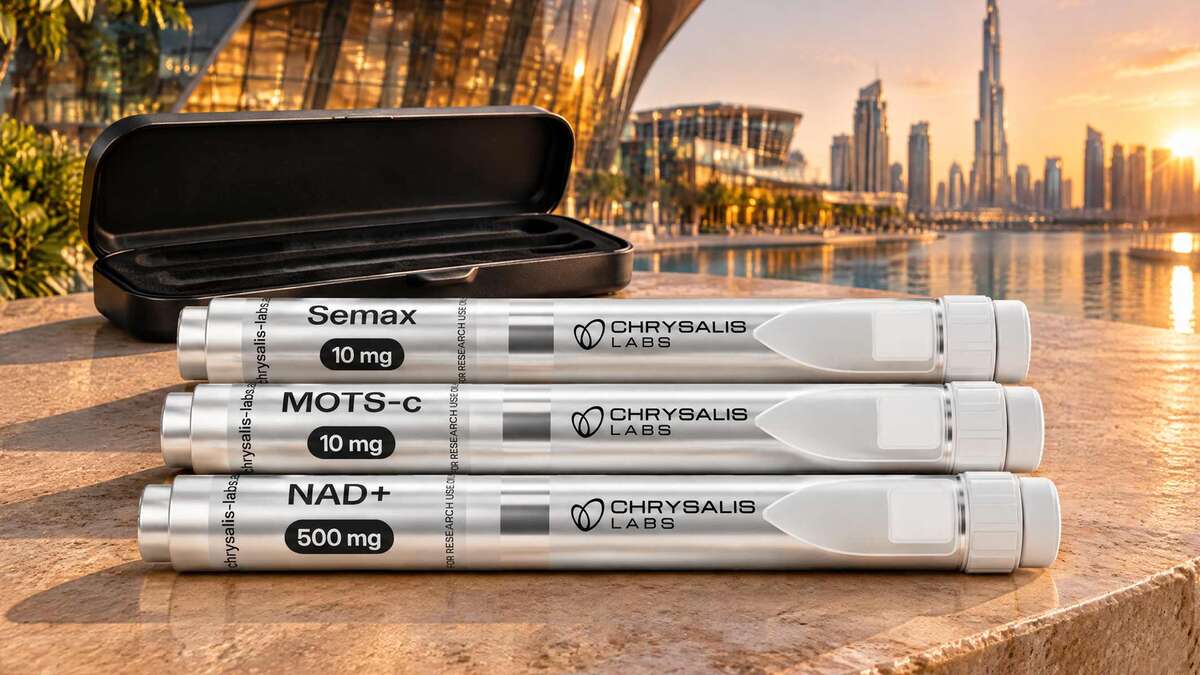
Our own pages: Vials · Pens · the product pages linked above
Chrysalis Labs is lab-verified and delivers to all seven emirates.
Strictly for in-vitro laboratory research. Not for human or veterinary use.
Chrysalis Labs Research Team · Facts checked
Four parts, one sealed solution, and a number on the label that tells you less than it seems to.
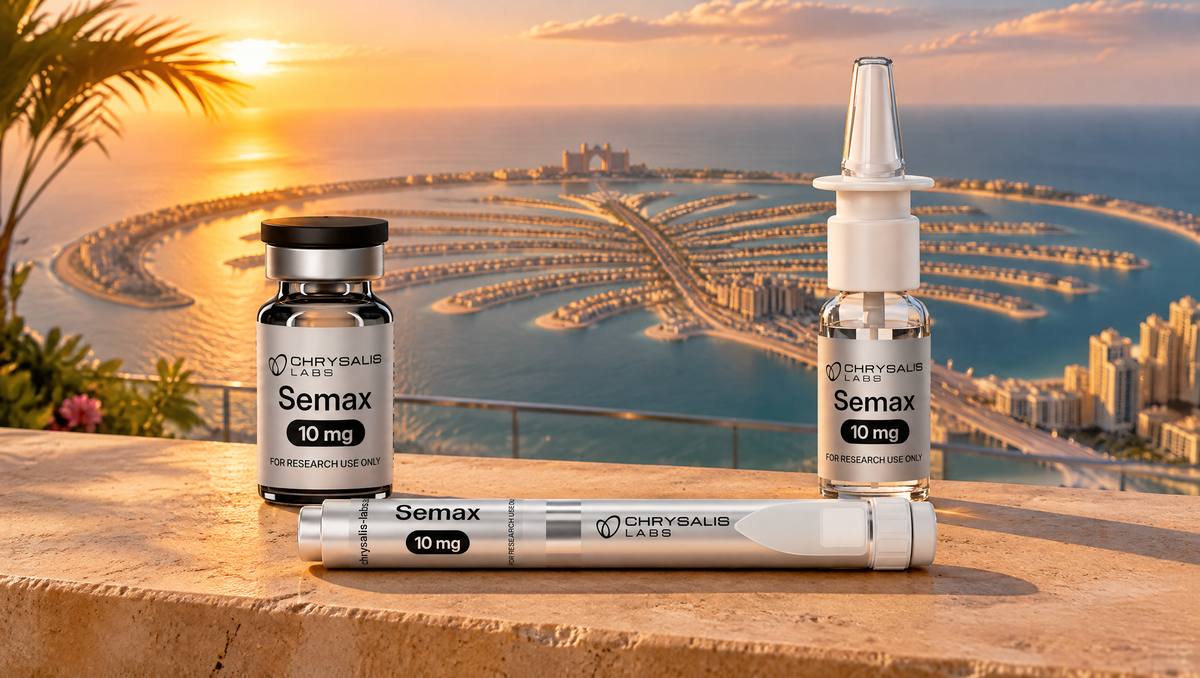
Same molecule, same 10 mg on the label, three containers. One of them goes straight into the fridge, and one is the only format you can’t pay for at the door.
Short chains of amino acids, built in a lab one link at a time. Here is what that means, in plain words.