

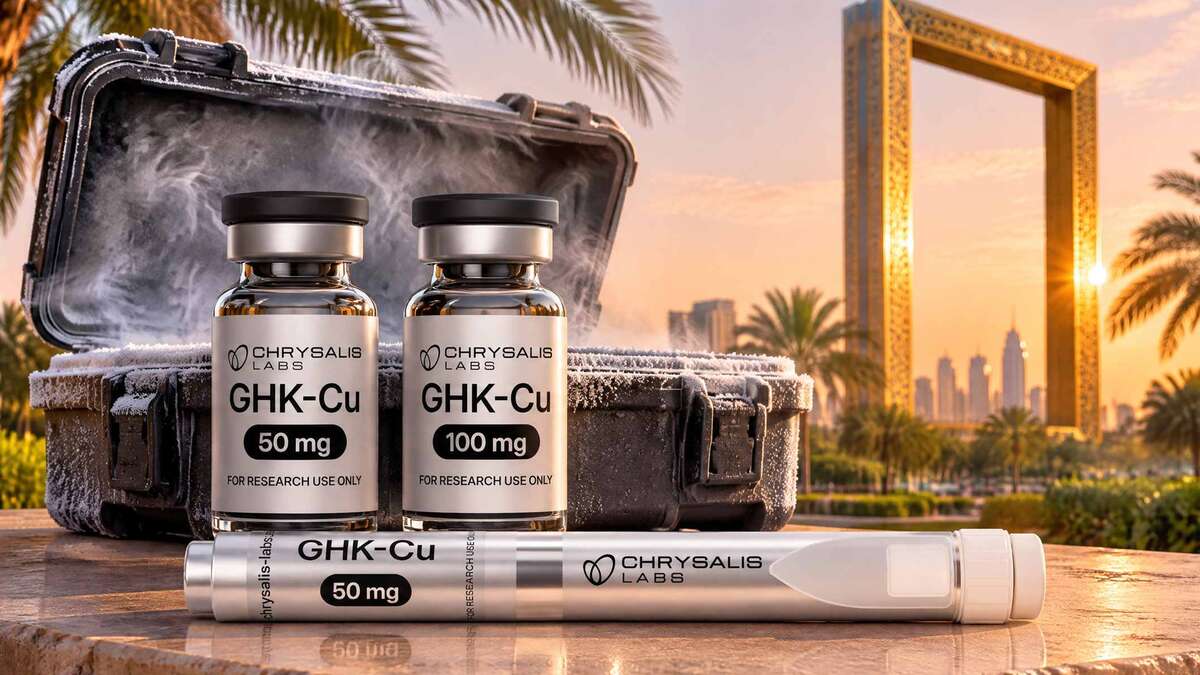
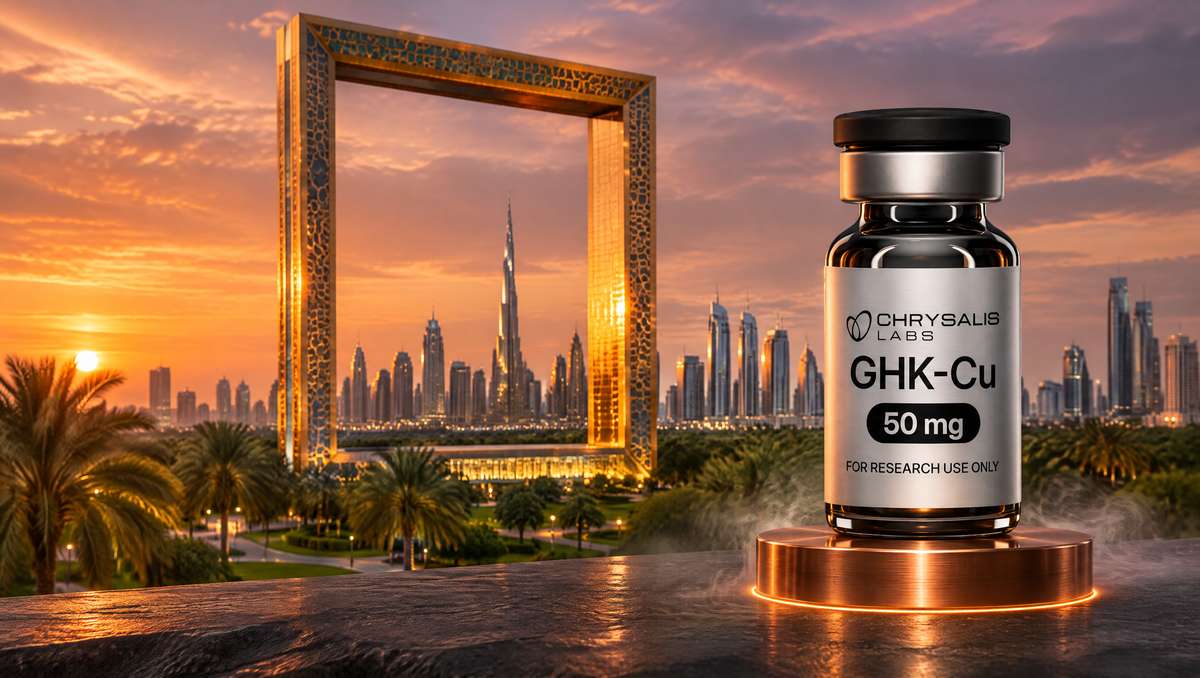
GHK-Cu sizes: 50 mg, 100 mg, vial or pen
Up to about 16 mg of every 100 mg on a GHK-Cu label is copper, not peptide. What the number holds, and how to put a 50 mg and a 100 mg unit on one price scale.
Everything on this site is supplied strictly for in-vitro laboratory research. Not for human or veterinary use.
See our Research Use Only policy (opens in a new tab)For research use only


Research areas
Strictly for in-vitro laboratory research. Not for human or veterinary use.
The short answer
GHK-Cu is a tiny peptide, three amino acids holding one copper ion, and the copper is what makes it blue. It was first found in human blood in 1973 and is now made in labs for research.
The name spells out the molecule. G, H and K are the one-letter codes for three amino acids, glycine, histidine and lysine, and Cu is the chemical symbol for copper, from its Latin name, cuprum.
Amino acids are the building blocks of proteins, and a few of them joined in a row make a peptide. Plenty of peptides run to dozens of amino acids. GHK has only three, which makes it a tripeptide.
On its own the peptide is called GHK. Once it holds a copper ion, it becomes the complex GHK-Cu.2
In 2011 a team in France mapped the complex in detail. In water, three nitrogen atoms grip the copper: one at the start of glycine, one in the joint where glycine meets histidine, and one in histidine's ring.3
On paper, GHK weighs 340.38 grams per mole.4 With the copper added, the complex comes to roughly 400,9 and the exact figure depends on the form the supplier names on its certificate.
GHK-Cu is meant to be blue, and the blue belongs to the copper. Like most short peptides, GHK on its own is a white powder.
White light is a mix of every colour. The copper in GHK-Cu is in its charged copper(II) form, and it soaks up part of the orange and red light that hits it.10 Your eye sees the light that is left, the complementary colour, and that looks blue.5
So the colour tells you copper is present. It can't tell you how pure the powder is, or whether the peptide is the right one. Even the shade can shift with conditions such as acidity, because copper and GHK can form more than one kind of complex.2,3 Only lab tests settle those questions, and section 5 covers which ones.
Loren Pickart and Melvin Thaler first reported GHK in 1973, after finding it in the liquid part of human blood.1
Later work turned to the way it holds copper. A 1982 lab study found that in water that is neither acidic nor alkaline, one GHK holds one copper ion.2
Found in human blood. Pickart and Thaler report the tripeptide.1
One GHK, one copper. The complex is studied in water.2
The grip studied in detail. Three nitrogen atoms hold the copper.3
Made in labs. Built by chemistry and freeze-dried for research.
This guide sticks to that chemistry: what the molecule is and how it holds a metal.
Research GHK is made by chemistry, not taken from blood. Like most peptides today, it is built by solid-phase synthesis, where the chain grows one amino acid at a time, in a set order, on tiny resin beads.7 Copper is added after that, and as GHK grabs it, the solution turns blue.
The water then comes out by freeze-drying, also called lyophilisation. The blue solution is frozen and put under a vacuum, so the ice turns straight into vapour and leaves.8 What stays behind is a dry, light "cake" that can break into powder.
A dry solid generally keeps better than the same compound sitting in water,8 which is why most research peptides travel as powder.
GHK-Cu supplied as a solution in a sealed pen. 50 mg or 100 mg per pen. Pens go in the fridge on arrival.
50 mg pen 100 mg penThe number on the label, such as 50 mg, is the amount of compound in that one unit.
A certificate of analysis, or COA, is the lab report for one batch. On a GHK-Cu report, four questions matter most.
1Look
Appearance. Is it a blue powder or cake, as expected?
2Weigh
Identity, by mass spec. The machine weighs the molecules, and GHK should appear at its known weight.
3Separate
Purity, by HPLC. The sample is split into its parts, and small extra peaks are other things, such as a chain with a bead missing.7
4Measure
Content. How many milligrams of compound are really in the vial?
Purity and identity are two separate questions. A sample can be 99% one thing and still be the wrong molecule, so a good report shows both.
Purity and identity: two different questions · How to read a certificate of analysis
Heat, light and damp can each slowly break a peptide down, which is why the basic rule is to keep it sealed, cool, dry and dark.
Our storage guidance fits in three lines. Freeze-dried peptides are stable at room temperature for short periods. For long-term storage, keep sealed vials at −20 °C, away from light. Pens are kept at 2–8 °C.
In the UAE, the main heat risk is the time a parcel spends on the road, so delivery time matters. In Dubai and Sharjah, orders placed before 14:00 on a working day usually arrive the next working day.
AHK-Cu is a close cousin in which alanine (A) takes the place of glycine (G) as the first bead. Histidine and lysine stay the same.
Alanine is glycine with one extra small carbon group, so AHK comes out a little heavier: 354.41 grams per mole, against 340.38 for GHK.4,6 Like GHK-Cu, it is supplied as a copper complex.
They are still different molecules, and a mass spec test tells them apart by weight. That is one more reason identity testing matters.
Strictly for in-vitro laboratory research. Not for human or veterinary use.
Yes. GHK is a tripeptide, a chain of three amino acids, and with copper attached it becomes a peptide–copper complex.
Yes. The blue comes from the copper(II) ion, which takes in part of the orange-red light. The colour shows that copper is there, but only lab tests confirm identity and purity.
Cu is the chemical symbol for copper, from its Latin name, cuprum.
The vial holds freeze-dried powder in sealed glass, while the pen holds the compound as a solution and is kept in the fridge. Both come in 50 mg and 100 mg.
Yes, to all seven emirates. In Dubai and Sharjah, orders placed before 14:00 on a working day usually arrive the next working day.
Vials and pens, delivered across all seven emirates. Cash on delivery available.
Strictly for in-vitro laboratory research. Not for human or veterinary use.
Chrysalis Labs Research Team · Published
Up to about 16 mg of every 100 mg on a GHK-Cu label is copper, not peptide. What the number holds, and how to put a 50 mg and a 100 mg unit on one price scale.
They share a vial and a plus sign, not a molecule: BPC-157 is 15 amino acids, and TB-500 is either a 7-amino-acid fragment or the full thymosin beta-4. Here is how they compare, and what “5 mg + 5 mg” really counts.
Catalogues often use the two names as one. The molecules behind them differ by 36 amino acids and more than 4,000 g/mol.