

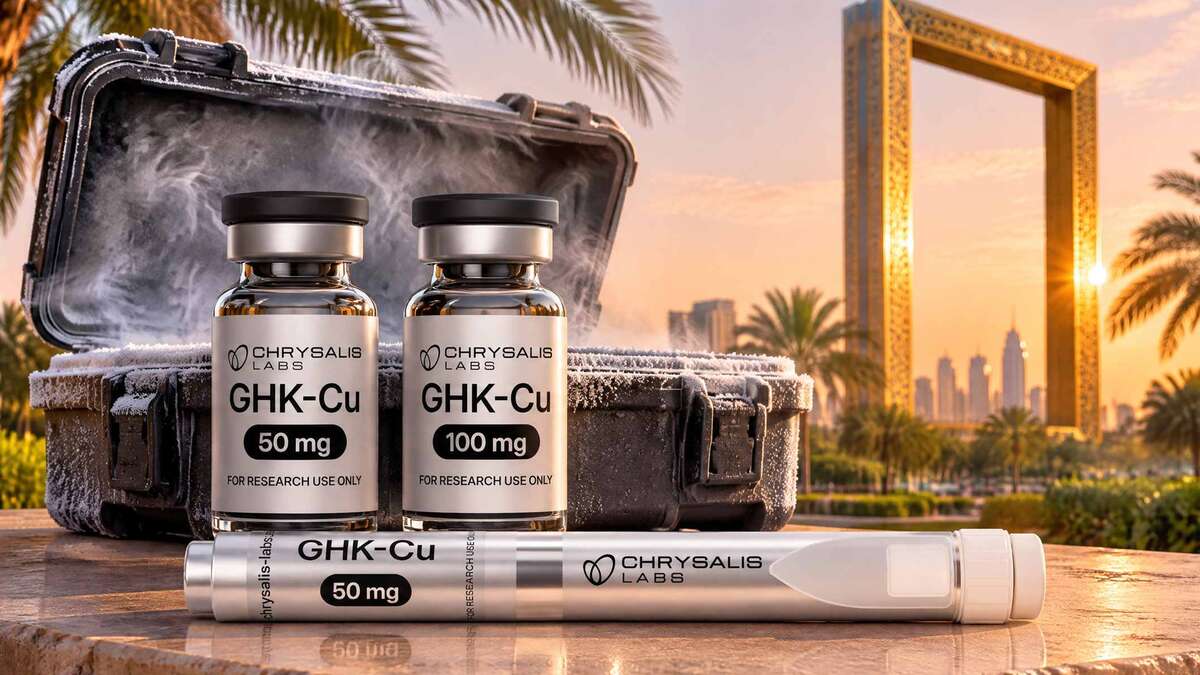
GHK-Cu sizes: 50 mg, 100 mg, vial or pen
Up to about 16 mg of every 100 mg on a GHK-Cu label is copper, not peptide. What the number holds, and how to put a 50 mg and a 100 mg unit on one price scale.
Everything on this site is supplied strictly for in-vitro laboratory research. Not for human or veterinary use.
See our Research Use Only policy (opens in a new tab)For research use only


Research areas
Strictly for in-vitro laboratory research. Not for human or veterinary use.
The short answer
MOTS-c is a small peptide, a chain of 16 amino acids whose code sits in mitochondrial DNA, the tiny set of genes inside the cell's power plants. It was first described in 2015 and is now made in labs for research.
Like every peptide, MOTS-c is a short chain of amino acids, the building blocks of proteins. It has 16 of them, always in the same order.1
Written in one-letter codes, MOTS-c reads MRWQEMGYIFYPRKLR.1 The order matters, because swapping or dropping one letter gives a different molecule.
M methionine · R arginine · W tryptophan · Q glutamine · E glutamic acid · G glycine · Y tyrosine · I isoleucine · F phenylalanine · P proline · K lysine · L leucine
Twelve different amino acids make up the chain. Arginine (R) appears three times, and methionine (M) and tyrosine (Y) twice each.
Count every atom and you get the formula C101H152N28O22S2, with the two sulfur atoms (S) coming from the two methionines. On paper, the chain weighs 2,174.6 grams per mole.2
Most of a cell's DNA sits in its nucleus, the control centre. Mitochondria, the tiny power plants inside cells, also carry a small amount of DNA of their own,3 shaped like a closed loop.
The loop is short. In humans it has 16,569 letters and 37 genes,4,3 two of which are called 12S and 16S rRNA.4 Instead of a protein recipe, these two hold the code for RNA that becomes part of the machine that builds proteins.3
The MOTS-c recipe is tucked inside the 12S rRNA gene.1 DNA is read three letters at a time, with each group of three standing for one amino acid. So 16 amino acids need 48 letters, plus a short "stop" code at the end.
The name comes from that stretch: MOTS-c is short for "mitochondrial open reading frame of the 12S rRNA-c".1 An open reading frame is a run of DNA letters with a "start" code at one end and a "stop" code at the other, and everything in between reads as a recipe.
There is a twist. Mitochondria read their DNA with a slightly different code from the rest of the cell. Read their way, this recipe stops almost as soon as it starts, while the cell's standard code gives the full 16-bead chain. So the chain is thought to be built outside the mitochondria, in the fluid of the cell.1
Thirteen of the 37 mitochondrial genes are standard protein recipes,3 and MOTS-c is not one of them. Its short recipe hides inside an rRNA gene, a gene whose main job is to make RNA rather than protein.
Short chains whose code sits in mitochondrial DNA are called mitochondrial-derived peptides.1 MOTS-c was not the first one found. Humanin, a 24-amino-acid peptide reported in 2001, has its code in the other rRNA gene, 16S.5 Section 7 compares the two.
The full map. All 16,569 letters of human mitochondrial DNA are read.4
Humanin. A 24-bead peptide, coded in the 16S rRNA gene.5
MOTS-c. First described: 16 beads, coded in the 12S rRNA gene.1
Made in labs. Built by chemistry and freeze-dried for research.
This guide sticks to those facts: what the molecule is and where its code sits. If you go on to read the research papers yourself, our guide on reading past the summary will help.
Research MOTS-c is made by chemistry, not taken from cells. Like most peptides today, it is built by solid-phase synthesis, where the chain grows one amino acid at a time, in a set order, on tiny resin beads.6 For MOTS-c that means 16 beads, added one by one.
The water then comes out by freeze-drying, also called lyophilisation. The solution is frozen and put under a vacuum, so the ice turns straight into vapour and leaves.7 What stays behind is a dry, light "cake" that can break into powder.
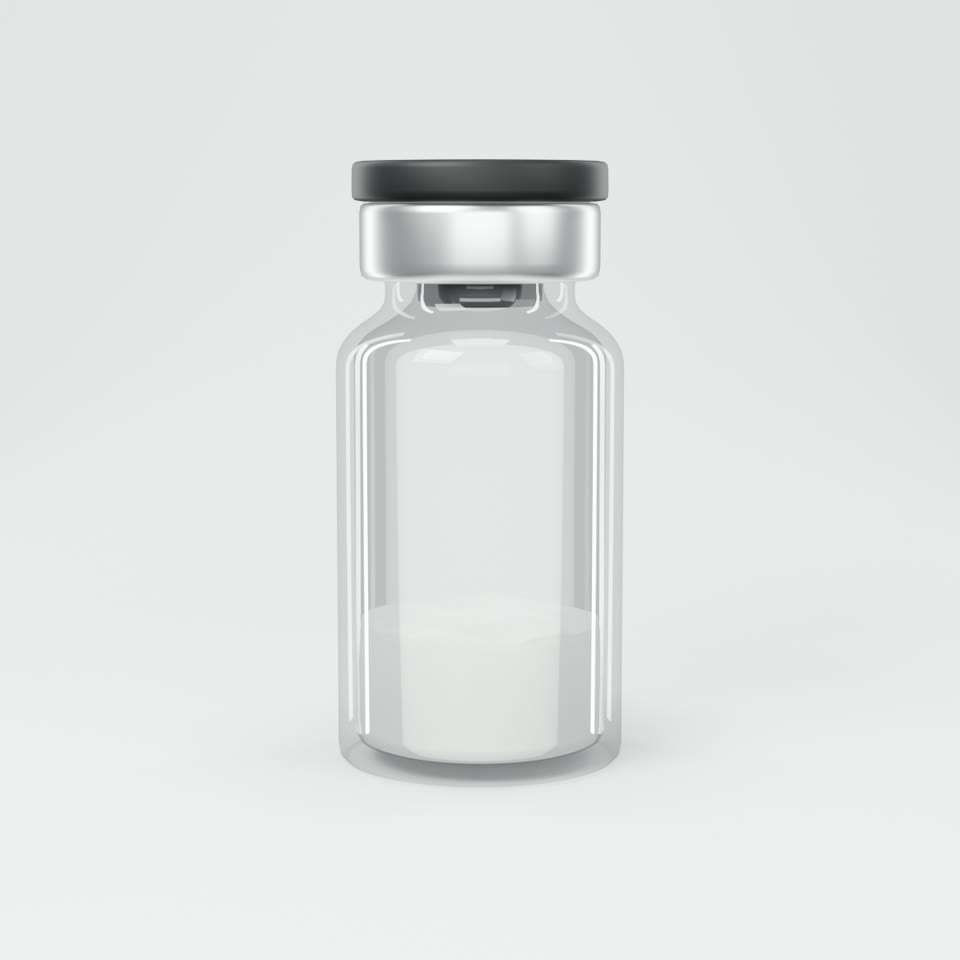
A dry solid generally keeps better than the same compound sitting in water,7 which is why most research peptides travel as powder.
MOTS-c supplied as a solution in a sealed pen. 10 mg, 20 mg or 40 mg per pen. Pens are kept in the fridge.
10 mg pen 20 mg or 40 mg penThe number on the label, such as 10 mg, is the amount of compound in that one unit.
A certificate of analysis, or COA, is the lab report for one batch. For MOTS-c, the same four questions matter as for any research peptide.
1Look
Appearance. Does the powder or cake look as the certificate describes?
2Weigh
Identity, by mass spec. The machine weighs the molecules, and MOTS-c should appear at its known weight.
3Separate
Purity, by HPLC. The sample is split into its parts, and small peaks are other things, such as a chain with a bead missing.6
4Measure
Content. How many milligrams of compound are really in the vial?
Identity is where the size of MOTS-c matters. In electrospray mass spec, a kind often used for peptides, molecules pick up electric charges before they are weighed, and the machine reads weight divided by charge.8
A 16-bead chain can pick up two, three or four charges, so one molecule can show up as several peaks: near 1,088 with two charges, 726 with three and 545 with four. Each charge comes with one extra hydrogen, which adds about 1 to the weight.8 Take that off and every peak points back to the same whole weight, about 2,175.2,8
A good report says which peak it used and what whole weight it worked out from it.
Two of the beads need extra care. MOTS-c has two methionines (M), and oxygen can attach to methionine's sulfur atom.9 The chain is then one oxygen atom heavier, by about 16 units, and shows up as a separate small peak. Oxidised chains are one of the impurity types these tests look for.6
Purity and identity are two separate questions. A sample can be 99% one thing and still be the wrong molecule, so a good report shows both.
Purity and identity: two different questions · Seven checks before you buy research peptides in the UAE
Heat, light and damp can each slowly break a peptide down, and with two oxygen-sensitive methionines, MOTS-c has one more reason to stay sealed. The basic rule is to keep it sealed, cool, dry and dark.
Our storage guidance fits in three lines. Freeze-dried peptides are stable at room temperature for short periods. For long-term storage, keep sealed vials at −20 °C, away from light. Pens are kept at 2–8 °C.
Humanin belongs to the same family, since both are short peptides whose code sits in mitochondrial DNA. They differ in length, in which rRNA gene holds their code, and in when they were first reported.
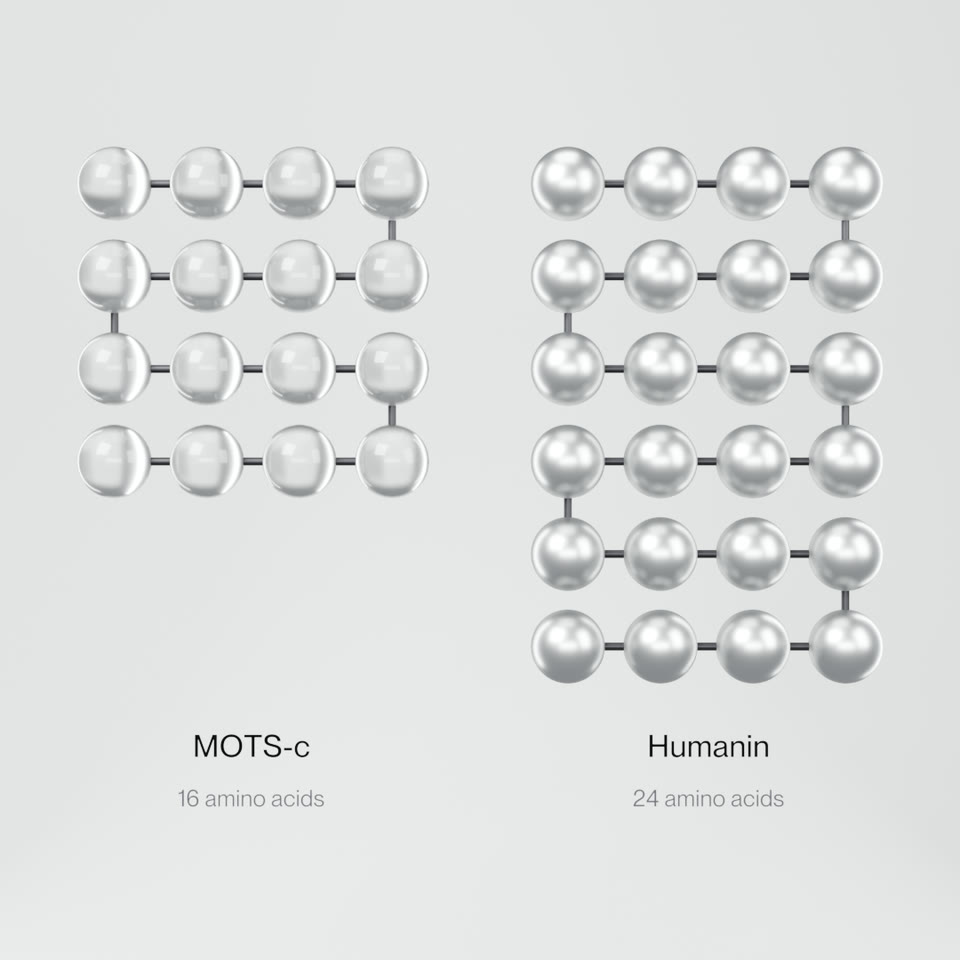
| Feature | MOTS-c | Humanin |
|---|---|---|
| Length | 16 amino acids | 24 amino acids |
| Code sits in | 12S rRNA gene | 16S rRNA gene |
| First reported | 2015 | 2001 |
| Molecular weight | 2,174.6 g/mol | 2,687.2 g/mol |
| Sequence | MRWQEMGYIFYPRKLR | MAPRGFSCLLLLTSEIDLPVKRRA |
Humanin has a twist of its own. Read with the mitochondria's code, its recipe would give a chain three beads shorter.5
They are still different molecules. Their weights differ by more than 500, so a mass spec test tells them apart at once.2,10
Strictly for in-vitro laboratory research. Not for human or veterinary use.
MOTS-c is a peptide, a chain of 16 amino acids whose code sits in mitochondrial DNA. It was first described in 2015, and research MOTS-c is made in labs.
Mitochondrial open reading frame of the 12S rRNA-c. The name says where its code sits: inside the 12S rRNA gene of mitochondrial DNA.
MRWQEMGYIFYPRKLR. That is 16 amino acids, from methionine (M) at the start to arginine (R) at the end.
About 2,174.6 g/mol, with the formula C101H152N28O22S2. Both come from its PubChem record, CID 146675088.
No. It is built by chemistry, one amino acid at a time, and then freeze-dried into a dry powder or cake.
A freeze-dried vial in 10 mg or 40 mg, and a pen in 10 mg, 20 mg or 40 mg. The pen holds the compound as a solution and is kept in the fridge.
Freeze-dried vials in 10 mg and 40 mg. Pens in 10 mg, 20 mg and 40 mg.
Strictly for in-vitro laboratory research. Not for human or veterinary use.
Chrysalis Labs Research Team · Published
Up to about 16 mg of every 100 mg on a GHK-Cu label is copper, not peptide. What the number holds, and how to put a 50 mg and a 100 mg unit on one price scale.
They share a vial and a plus sign, not a molecule: BPC-157 is 15 amino acids, and TB-500 is either a 7-amino-acid fragment or the full thymosin beta-4. Here is how they compare, and what “5 mg + 5 mg” really counts.
Catalogues often use the two names as one. The molecules behind them differ by 36 amino acids and more than 4,000 g/mol.