

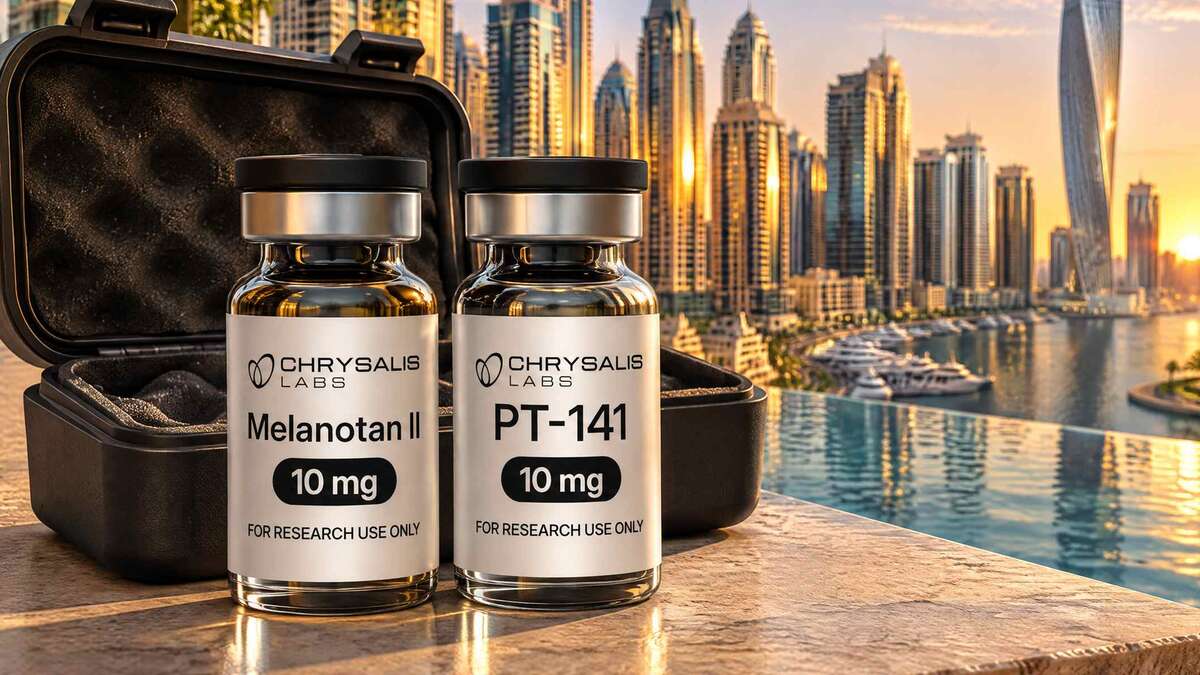
Melanotan II vs PT-141: one ring, two ends
Two lab-made peptides with the same seven amino acids and the same ring. One small group of atoms at the tail end sets them apart.
Everything on this site is supplied strictly for in-vitro laboratory research. Not for human or veterinary use.
See our Research Use Only policy (opens in a new tab)For research use only


Research areas
Strictly for in-vitro laboratory research. Not for human or veterinary use.

The short answer
NAD+ is a coenzyme built from two nucleotides, while MOTS-c is a peptide: a chain of 16 amino acids whose code sits in mitochondrial DNA.3,5,6 MOTS-c is also the bigger molecule, at 2,174.6 g/mol against 663.4 g/mol for NAD+, so about 3.3 times as heavy.1,4 NAD+ was discovered in 1906; MOTS-c was named in 2015.10,6
Chrysalis Labs lists NAD+ as a 500 mg Vial and a 500 mg Pen, and MOTS-c as a Vial (10 or 40 mg) or a Pen (10, 20 or 40 mg), as of 17 Nov 2026.
Strictly for in-vitro laboratory research. Not for human or veterinary use.
Ten facts side by side. The sections below take them one at a time.
| Fact | NAD+ | MOTS-c |
|---|---|---|
| Kind of molecule | Coenzyme3 | Peptide5 |
| Built from | 2 nucleotides, joined through their phosphates3 | 16 amino acids, 15 peptide bonds5 |
| Formula | C21H27N7O14P21 | C101H152N28O22S24 |
| Molecular weight | 663.4 g/mol1 | 2,174.6 g/mol4 |
| Atoms in one molecule | 71 | 305 |
| Element only it has | Phosphorus (2 atoms) | Sulfur (2 atoms) |
| Where its recipe is | No gene: enzymes build it from smaller molecules8 | 51 letters of mitochondrial DNA6 |
| Where it is found | Cytoplasm, nucleus, mitochondria8 | Mitochondrion, nucleus, outside the cell5 |
| First described | 190610 | 20156 |
| At Chrysalis Labs | Vial 500 mg · Pen 500 mg | Vial 10 or 40 mg · Pen 10, 20 or 40 mg |
NAD+ is a coenzyme, a helper molecule that enzymes need.3 Its full name, nicotinamide adenine dinucleotide, is a parts list. It is found in all living cells, where it carries electrons from one reaction to another.2
The trick is a simple swap. NAD+ takes up a hydride ion, a hydrogen with two electrons, and becomes NADH.8 NADH hands the electrons on and turns back into NAD+.3
MOTS-c is a peptide: 16 amino acids in a fixed order, written MRWQEMGYIFYPRKLR.5 The name is short for “mitochondrial open-reading-frame of the twelve S rRNA-c”: an address for where its code was found.6
So the first difference is the deepest: NAD+ contains no amino acids and no peptide bonds. Is NAD+ a peptide? takes that question apart bond by bond.
NAD+ is two nucleotides joined back to back. A nucleotide is the unit DNA and RNA are made of: a base, a sugar and a phosphate. One half of NAD+ carries the base nicotinamide, the other adenine, and the halves meet through their phosphates in a pyrophosphate link.3
MOTS-c is one unbroken row. Sixteen amino acids, fifteen peptide bonds. Twelve different amino acids make up the row: arginine (R) appears three times, methionine (M) and tyrosine (Y) twice each.5
Read the two formulas and each molecule signs its name with one element.
One element each, never the other's
NAD+ C21H27N7O14P2
MOTS-c C101H152N28O22S2
Neither has the other's element. Carbon, hydrogen, nitrogen and oxygen they share; that one letter they don't.
About 3.3 times. NAD+ weighs 663.4 g/mol,1 MOTS-c 2,174.6 g/mol.4 Grams per mole, g/mol, is the chemist's unit for how heavy a molecule is. Count the atoms and the gap grows: 71 in one NAD+ molecule, 305 in one MOTS-c molecule.
Molecular weight, on one scale
Why it matters on a label. A label gives weight in milligrams, and lighter molecules pack more copies into each milligram. Milligram for milligram, NAD+ holds about 3.3 times as many molecules as MOTS-c. That is our own arithmetic from the two weights.
You may also see 664.4 g/mol for NAD+. Same molecule, written as the charged ion with one extra hydrogen.2
Weight is also how a mass spectrometer tells them apart: NAD+ shows up near 664,2 MOTS-c near a whole weight of 2,175.4 A 16-amino-acid chain often carries several charges and shows as a set of peaks; What is MOTS-c? walks through them.
NAD+ has no gene. No stretch of DNA spells it out. Enzymes assemble it from smaller molecules, and one route starts from the amino acid tryptophan. Most cells outside the liver lack the full set of enzymes for that route.8
MOTS-c has a recipe, in an odd place: 51 DNA letters inside the 12S rRNA gene of mitochondrial DNA,6 a gene whose main job is to make RNA for the mitochondria's own protein-building machinery. DNA is read three letters at a time, so 16 amino acids take 48 letters. The last three spell “stop”.
Mitochondria read their DNA with a slightly different genetic code. Read their way, this recipe gives a start and a stop back to back. So the 2015 paper that named MOTS-c concluded the chain is built outside the mitochondria, in the cytoplasm, with the standard code.6
The dates are a century apart. NAD+ was discovered in 1906,10 first identified in yeast extracts.8 MOTS-c was named in 2015,6 109 years later.
NAD+ and MOTS-c on paper
NAD+ keeps separate pools in the cytoplasm, the mitochondria and the nucleus.8 A 2016 study measured the free NAD+ in each pool of one standard lab cell line, HEK293T:9
µM means micromoles per litre. In those cells the mitochondria held roughly twice the concentration of the other two pools.
MOTS-c moves. Its code sits in the mitochondria and its chain is built in the cytoplasm. UniProt, the protein database, lists three places it is found: the mitochondrion, the nucleus and outside the cell.5 A 2018 study in cultured cells saw it move into the nucleus when glucose was restricted.7
So the mitochondria matter to both, in different ways: they held the richest pool of free NAD+ in that study, and they hold the code for MOTS-c.
Both come as a Vial and as a Pen. A Vial holds freeze-dried powder in sealed glass. A Pen arrives with the compound already in solution, sealed inside. Peptide vial, pen or spray sets the formats side by side, and Freeze-dried peptide powder shows what the dry cake in a Vial looks like.
All five listed as of . Each product page shows the live price in AED.
Our storage guidance: Pens in the fridge at 2–8 °C from the day they arrive. Sealed Vials in the freezer at −20 °C for the long term, away from light. The storage line on your label comes first. How to store research peptides in UAE heat
The same as for every order. Delivery is AED 25 to every emirate, free from AED 350 of products after discounts. Dubai and Sharjah orders placed before 14:00 usually arrive the next working day. Other emirates take 1–2 working days, Al Dhafra (Western Region) 2–3. Times are estimates.
Cash on delivery covers every Vial and Pen above. The fee is 5% of the product subtotal after discounts, minimum AED 20. Instalments or crypto show at checkout.
Buy 2, get 1 free counts per item: pay for two of the same item (same compound, same format, same amount) and the third is free. One free item per order.
Delivery, payment and offer facts as of . Delivery zones and charges
NAD+ is a coenzyme built from two nucleotides. MOTS-c is a peptide of 16 amino acids whose code sits in mitochondrial DNA. MOTS-c is about 3.3 times heavier: 2,174.6 g/mol against 663.4 g/mol.
About 3.3 times: 2,174.6 g/mol against 663.4 g/mol (PubChem). So milligram for milligram, NAD+ holds about 3.3 times as many molecules as MOTS-c (our arithmetic).
Its code is, in 51 letters of mitochondrial DNA. The chain itself is built in the cytoplasm: read with the mitochondria's own genetic code, the recipe is a start and a stop back to back.
In three main pools: the cytoplasm, the nucleus and the mitochondria. In one lab cell line, a 2016 study measured free NAD+ at about 106, 109 and 230 µM.
By weight and by formula. A mass spectrometer reads NAD+ near 664 and MOTS-c near a whole weight of 2,175. NAD+ contains phosphorus and no sulfur; MOTS-c contains sulfur and no phosphorus.
Chrysalis Labs lists NAD+ at 500 mg as a Vial or a Pen, and MOTS-c as a Vial (10 or 40 mg) or a Pen (10, 20 or 40 mg), as of 17 Nov 2026. Any of them goes to all seven emirates for AED 25, free from AED 350 of products, and cash on delivery covers them; orders are for researchers aged 21 and over. Strictly for in-vitro laboratory research. Not for human or veterinary use.
Our own pages: NAD+ compound profile · MOTS-c compound profile · Delivery zones and charges · FAQ · the catalogue
Chrysalis Labs: Lab-verified. Next working day in Dubai & Sharjah, cash on delivery.
Strictly for in-vitro laboratory research. Not for human or veterinary use.
Chrysalis Labs Research Team · Sources checked
Two lab-made peptides with the same seven amino acids and the same ring. One small group of atoms at the tail end sets them apart.
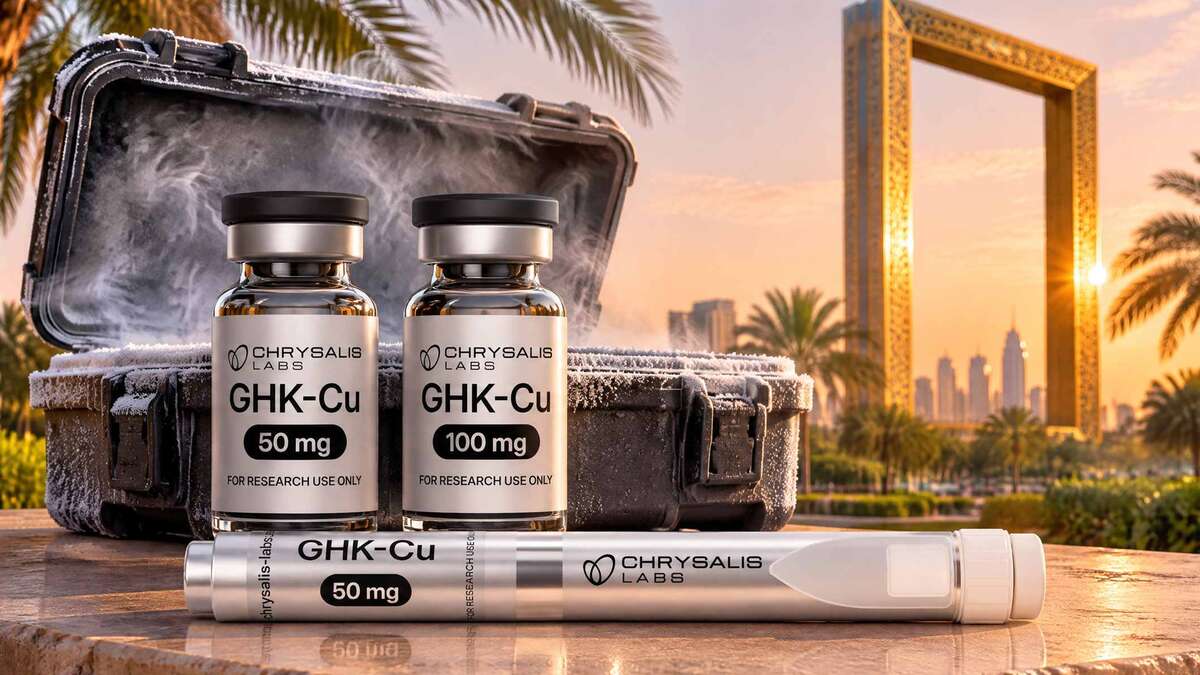
Up to about 16 mg of every 100 mg on a GHK-Cu label is copper, not peptide. What the number holds, and how to put a 50 mg and a 100 mg unit on one price scale.
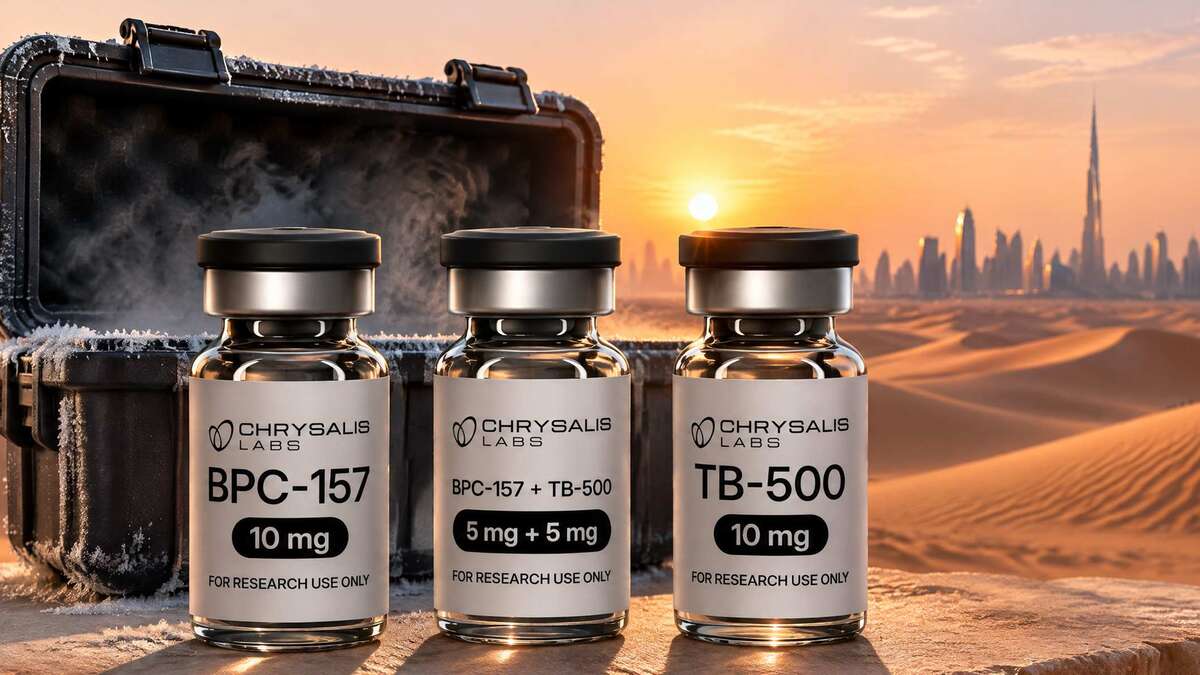
They share a vial and a plus sign, not a molecule: BPC-157 is 15 amino acids, and TB-500 is either a 7-amino-acid fragment or the full thymosin beta-4. Here is how they compare, and what “5 mg + 5 mg” really counts.