

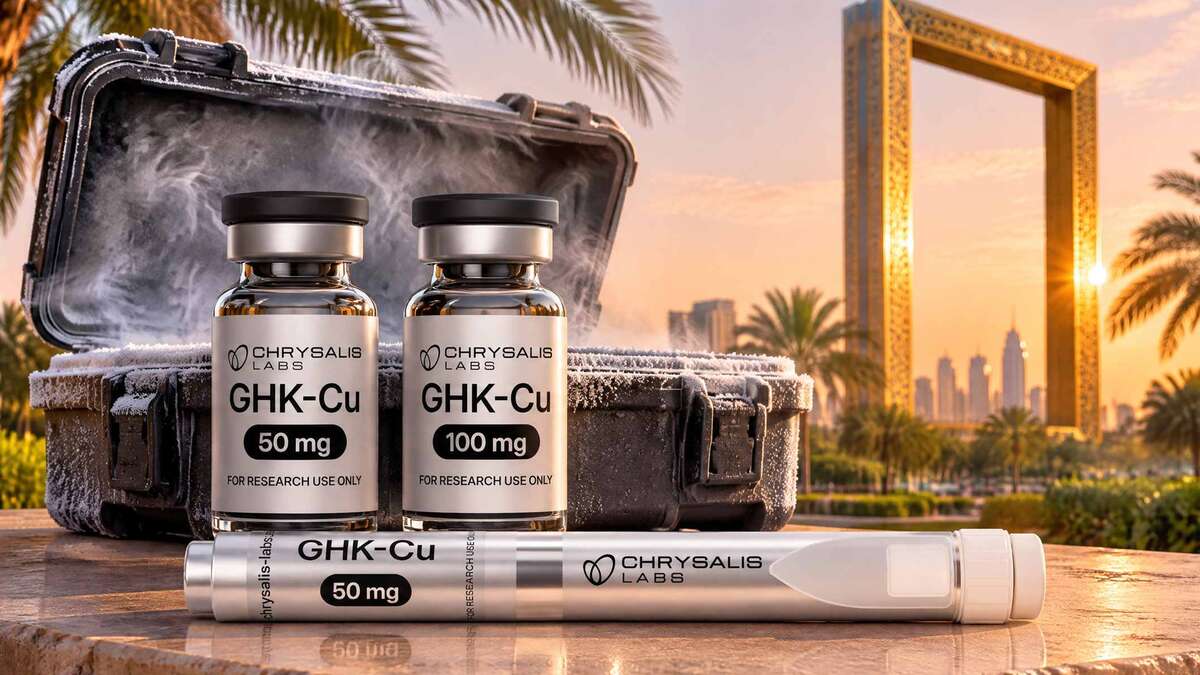
GHK-Cu sizes: 50 mg, 100 mg, vial or pen
Up to about 16 mg of every 100 mg on a GHK-Cu label is copper, not peptide. What the number holds, and how to put a 50 mg and a 100 mg unit on one price scale.
Everything on this site is supplied strictly for in-vitro laboratory research. Not for human or veterinary use.
See our Research Use Only policy (opens in a new tab)For research use only


Research areas
Strictly for in-vitro laboratory research. Not for human or veterinary use.

The short answer
Melanotan II and PT-141 are two lab-made peptides built from the same seven amino acids, six of them closed into the same ring. They differ at one spot, the tail end of the chain: Melanotan II ends in an amide group and PT-141 ends in an acid group, which makes PT-141 about 1 g/mol heavier (1025.2 against 1024.2).1,2
Chrysalis Labs lists Melanotan II as a Vial and a Pen, and PT-141 as a Vial, a Pen and a Spray, 10 mg each (as of 17 Nov 2026).
Strictly for in-vitro laboratory research. Not for human or veterinary use.
Structure from PubChem;1,2 ring size and design from the 1989 paper;4 listing as of .
Both are peptides, short chains of amino acids: seven in each, the same seven in the same order.1,2
A peptide is written from the front of the chain to its tail.3 In three-letter codes, the seven are:
Nle · Asp · His · D-Phe · Arg · Trp · Lys
In full: norleucine, aspartic acid, histidine, D-phenylalanine, arginine, tryptophan and lysine.1 The codes are explained in How to read a peptide sequence.
Six of the seven, from Asp to Lys, are closed into a ring. Norleucine sits outside it, at the front, with a small acetyl cap.
PubChem writes Melanotan II in one line: Ac-Nle-cyclo[Asp-His-D-Phe-Arg-Trp-Lys]-NH2. “Ac” is the cap, the square brackets hold the ring, and “NH2” is the tail end.1
Melanotan II, as written
Ac-Nle-cyclo[Asp-His-D-Phe-Arg-Trp-Lys]-NH2
PT-141 shares the cap, the seven amino acids and the ring.2 Only the tail end differs, as section 4 shows.
The model for both is a natural hormone, alpha-melanocyte-stimulating hormone, or alpha-MSH. It is a straight chain of 13 amino acids: Ser-Tyr-Ser-Met-Glu-His-Phe-Arg-Trp-Gly-Lys-Pro-Val.4
The ring is built on the middle of alpha-MSH, positions 4 to 10.4 Line the two up and you can count what changed.
Alpha-MSH, positions 4 to 10, against the ring peptides
3 kept, 3 swapped, 1 mirror form
Three amino acids are kept and three are swapped. The seventh, phenylalanine, is turned into its mirror form.1,4
Norleucine for methionine. Methionine has a sulfur atom in its side chain, the part of an amino acid that hangs off the main chain. Norleucine has a side chain of the same length with a carbon in that place,5,6 and it is not one of the 20 amino acids commonly found in proteins.7 So alpha-MSH has an S in its formula, and neither ring peptide does.1,2,8
D-phenylalanine for phenylalanine. Amino acids come in two mirror-image forms, L and D, and nature builds proteins from the L form only.7
In December 1989, Al-Obeidi, Castrucci, Hadley and Hruby described seven ring-shaped versions of alpha-MSH, with loops of 20 to 24 atoms, in a paper from the University of Arizona’s Department of Chemistry in Tucson. One has the structure now known as Melanotan II.1,4
Two of its swaps came from an earlier version of the full chain of 13, which already had norleucine at position 4 and D-phenylalanine at position 7.4 The 1989 step was to shorten the chain and close a ring.
Amide bonds hold a peptide chain together, each joining the acid group of one amino acid to the amine group of the next.3 This ring is closed by one extra amide bond, between two side chains.
Aspartic acid has a spare acid group on its side chain, and lysine a spare amine group.7 Here those two are joined, which ties the second amino acid of the seven to the last.1,2,4
An amide that closes a ring is called a lactam,9 so chemists call this link a lactam bridge.4
The loop it makes holds 23 atoms. The 1989 paper speaks of 23-membered rings, and the long systematic names on PubChem carry the same number: “cyclotricosane” means a ring of 23.1,4
In natural peptides, a bond between two sulfur atoms can close a loop instead.3 These two have no sulfur.
The tail end, which chemists call the C-terminus: the free end of the last amino acid, lysine.
The swap is small enough to count. Take NH2 off and put OH on: one nitrogen and one hydrogen leave, one oxygen arrives. The two formulas show exactly that.1,2
One ring, two tail ends
NH2 off, OH on: one nitrogen and one hydrogen leave, one oxygen arrives
The weights follow: PT-141 is about one unit heavier, 1025.2 g/mol against 1024.2. PubChem’s exact masses are 1024.52 for PT-141 and 1023.54 for Melanotan II, a gap of 0.98.1,2
A carboxylic acid group is a weak acid: in water it can give up a hydrogen ion and become negatively charged.10 An amide is nonbasic: unlike an amine, it does not pick up a hydrogen ion from watery acid.11
So PT-141’s tail can carry a negative charge in water. Melanotan II’s tail has no acid group to do that.
Start with what is written down. Four things never overlap:
Four things that never overlap
4 of 5 tell the two apart
On a lab report, purity and identity are two separate questions. A purity figure says how much of the sample is one thing. It can't say which of two near-twins that thing is. Weighing the molecule can. Here the two exact masses sit only 0.98 apart, so the measured mass has to be read closely.1,2
As of , Chrysalis Labs lists five products for these two compounds. Each holds 10 mg.
A Vial holds freeze-dried powder sealed in glass, a Pen the compound already in solution. PT-141 is one of three compounds we also list as a Spray, at 10 mg per bottle. The three formats compared: Peptide vial, pen or spray: the difference.
Five products, three formats
Delivery is the same for every order. AED 25 in every emirate, free from AED 350 of products after discounts. Dubai and Sharjah orders placed before 14:00 usually arrive the next working day. Other emirates take 1–2 working days, and Al Dhafra (Western Region) 2–3. Times are estimates. Delivery zones and charges
Payment depends on the format. Cash on delivery covers Vials and Pens, with a fee of 5% of the product subtotal after discounts, minimum AED 20. An order with a Spray in it has no cash on delivery.
Buy 2, get 1 free works on all five. Pay for two of the same item (same compound, same format, same amount) and the third one is free. One free item per order. A Melanotan II Vial plus a PT-141 Vial does not count: they are different items.
Delivery, payment and offer facts as of . Each product page shows the current price in AED.
One small group of atoms at the tail end of the chain. Melanotan II ends in an amide (–CONH2) and PT-141 ends in an acid (–COOH). The seven amino acids, the acetyl cap and the 23-atom ring are the same in both.
No. They share the seven amino acids and the ring, but they are two compounds with separate PubChem records: C50H69N15O9 and CID 92432 for Melanotan II, C50H68N14O10 and CID 9941379 for PT-141.
Melanotan II is 1024.2 g/mol and PT-141 is 1025.2 g/mol. Both figures are from PubChem. The gap of about one unit comes from the tail end: NH2 on Melanotan II, OH on PT-141.
At Chrysalis Labs, as of 17 Nov 2026, Melanotan II is listed as a Vial and a Pen, and PT-141 as a Vial, a Pen and a Spray. Each holds 10 mg.
Chrysalis Labs is a UAE online store that delivers to all seven emirates, for researchers aged 21 and over. As of 17 Nov 2026, delivery is AED 25, free from AED 350, and cash on delivery covers Vials and Pens, not Sprays. Each product page shows the current price and stock. Strictly for in-vitro laboratory research. Not for human or veterinary use.
Our own pages: Delivery zones and charges · FAQ · the catalogue
Delivered across all seven emirates. Cash on delivery on Vials and Pens.
Strictly for in-vitro laboratory research. Not for human or veterinary use.
Chrysalis Labs Research Team · Facts checked
Up to about 16 mg of every 100 mg on a GHK-Cu label is copper, not peptide. What the number holds, and how to put a 50 mg and a 100 mg unit on one price scale.
They share a vial and a plus sign, not a molecule: BPC-157 is 15 amino acids, and TB-500 is either a 7-amino-acid fragment or the full thymosin beta-4. Here is how they compare, and what “5 mg + 5 mg” really counts.
Catalogues often use the two names as one. The molecules behind them differ by 36 amino acids and more than 4,000 g/mol.