

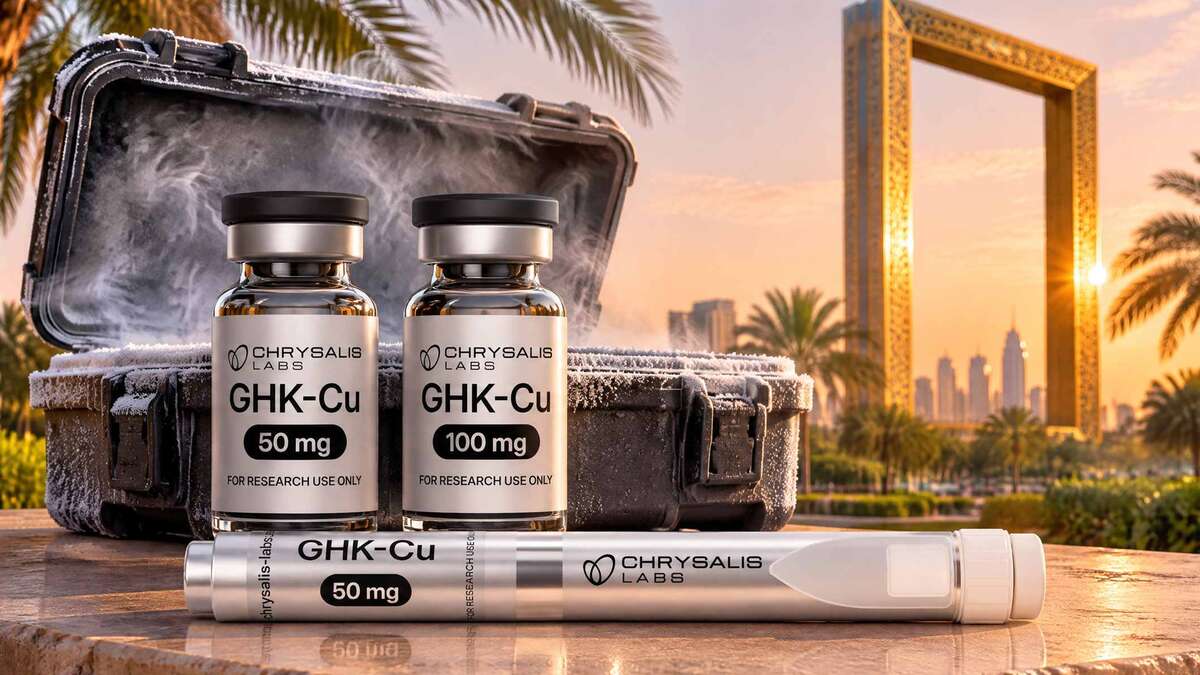
GHK-Cu sizes: 50 mg, 100 mg, vial or pen
Up to about 16 mg of every 100 mg on a GHK-Cu label is copper, not peptide. What the number holds, and how to put a 50 mg and a 100 mg unit on one price scale.
Everything on this site is supplied strictly for in-vitro laboratory research. Not for human or veterinary use.
See our Research Use Only policy (opens in a new tab)For research use only


Research areas
Strictly for in-vitro laboratory research. Not for human or veterinary use.

The short answer
NAD+ is not a peptide. It is a coenzyme built from two nucleotides joined by a bridge of two phosphate groups, with zero amino acids.1,3 A peptide is a chain of amino acids linked by peptide bonds.4
Full name: nicotinamide adenine dinucleotide, formula C21H27N7O14P2, 663.4 g/mol.1 The mix-up starts on the shelf, where it sits in the same Vials and Pens as peptides. Chrysalis Labs lists NAD+ as a 500 mg Vial and a 500 mg Pen (as of 17 Nov 2026).
Strictly for in-vitro laboratory research. Not for human or veterinary use.
| Fact | A peptide: Epithalon | NAD+ |
|---|---|---|
| Kind of molecule | Peptide | Coenzyme |
| Built from | 4 amino acids: Ala-Glu-Asp-Gly | 2 nucleotides: one with adenine, one with nicotinamide |
| Joined by | 3 peptide bonds | A bridge of 2 phosphate groups |
| Amino acids | 4 | 0 |
| Phosphorus atoms | 0 | 2 |
| Formula | C14H22N4O9 | C21H27N7O14P2 |
| Molecular weight | 390.35 g/mol | 663.4 g/mol |
| At Chrysalis Labs | Vial · Pen, 10 mg | Vial · Pen, 500 mg |
Chemistry read on PubChem on : NAD+,1,3 Epithalon.10 Key words from OpenStax.4,5,7
No, and the gap is wide. A peptide is a chain of amino acids. Each link is a peptide bond: the acid group of one amino acid joins the amino group of the next, and a molecule of water leaves.4 Epithalon is a clean example: Ala-Glu-Asp-Gly, four amino acids, three bonds.10
NAD+ has no amino acids, so there is nothing for a peptide bond to join. It is built from two nucleotides,3 and a nucleotide is a different unit altogether: a base, a five-carbon sugar and a phosphate group.5
The surprise: nucleotides are also the units DNA and RNA are built from.5 By building blocks, NAD+ is closer kin to DNA and RNA than to any peptide on the shelf next to it.
Chemists file it under coenzymes: organic helper molecules that enzymes need.3,7 One of its other names says so outright: coenzyme I.1
Our own compound profile files it the same way. Molecule class: Coenzyme. NAD+ compound profile
The name is the parts list. Nicotinamide adenine dinucleotide: two nucleotides, one carrying the base adenine, the other carrying nicotinamide, joined through their phosphate groups.3
Lay it out end to end and you count six parts: nicotinamide, ribose, phosphate, phosphate, ribose, adenine. The two phosphates in the middle are the bridge, a phosphate-to-phosphate link.12 Each half has its own sugar, a ribose.3,12
NAD+, part by part
Nam–Rib–P–P–Rib–Ade
P, for phosphorus. NAD+ is C21H27N7O14P2.1 That P2 is two phosphorus atoms: the bridge. Epithalon (C14H22N4O9) and Semax (C37H51N9O10S) carry none.10,11
Its PubChem record also lists diphosphopyridine nucleotide (DPN) and the CAS number 53-84-9.1
Because of where it sits. Stores list NAD+ in the same Vials and Pens as peptides, so “NAD+ peptide” became shelf talk. The molecule never changed.
Its size helps the confusion. At 663.4 g/mol, NAD+ is heavier than Epithalon, a peptide of four amino acids (390.35), and lighter than Semax, a peptide of seven (813.9).1,10,11 By weight it lands among short peptides. Its class comes from its building blocks.
Three molecular weights
Yes, and that is the trap. An amide has a nitrogen atom bonded to the carbon of a carbonyl group,8 and the nicotinamide ring carries one: the “amide” in its name.9
A peptide bond is also an amide, one that links two amino acids.8 The amide in NAD+ hangs off a ring and links nothing.
Side by side with a real peptide: NAD+ vs MOTS-c: a coenzyme and a peptide.
One molecule, two states. NAD+ is the oxidised form. NADH is the same molecule after it has taken up two electrons and a proton.6 In cells, the pair passes electrons from one reaction to the next.2
Only one of the six parts changes: the nicotinamide ring.6,12 The other five stay the same.
One molecule, two forms
One part changes, five stay the same
A positive charge on that same ring. PubChem's record of the charged form shows a charge of +1 and names the ring “pyridin-1-ium”.2 The NADH record names it “4H-pyridin”, charge 0.3 The 663.4 g/mol in this guide is PubChem's form with no net charge: one phosphate carries a minus charge that balances the ring.1
With ultraviolet light. Both forms absorb at 260 nm. Only NADH absorbs at 340 nm.12 A 1976 study averaged 85 measurements to pin down how strongly NADH absorbs at 340 nm, its molar absorptivity: 6,317 L per mole per cm, at 25 °C and pH 7.8.13
The two also break down under opposite conditions in solution: NAD+ at high pH, NADH at low pH.12
In our catalogue: both product pages describe the compound as “oxidized nicotinamide adenine dinucleotide”, which is NAD+. NADH is not listed (as of 17 Nov 2026).
The amount of NAD+ in that one unit: 500 milligrams, half a gram. Our Vial label reads NAD+, 500 mg and “For Research Use Only”. The Pen is listed at the same amount.
It is the largest amount per unit in our catalogue, five times the next largest, 100 mg (as of 17 Nov 2026).
Milligrams do not count molecules. Chemists count them in moles. One mole of NAD+ weighs 663.4 g,1 so 500 mg is about 0.75 millimoles. A 10 mg Epithalon Vial holds about 0.026 millimoles.10 In molecules, the NAD+ Vial holds roughly 29 times as many as the Epithalon Vial. Our arithmetic, rounded.
Same compound, same 500 mg, two containers: the NAD+ Vial and the NAD+ Pen. A Vial holds freeze-dried powder sealed in glass. A Pen is pre-filled: the compound arrives already in solution, sealed inside. All formats compared: Peptide vial, pen or spray: the difference.
Warmth speeds up chemistry, and a few degrees make a measurable difference. A 2024 bench study kept NAD+ and NADH in solution for up to 43 days. In its most stable buffer, going from 19 to 25 °C took NADH's loss from 4 to 11 micromolar a day: six degrees, nearly three times the loss.12
The storage line on your label comes first. Our general guidance for sealed products: Pens in the fridge at 2–8 °C from the day they arrive, sealed Vials in a freezer at −20 °C for the long term, away from light.
In UAE heat, be there to receive the parcel and put it away on the day it arrives. More in Storing peptide pens in UAE heat.
Chrysalis Labs is an online store in Dubai that delivers to all seven emirates, for researchers aged 21 and over. Each NAD+ product page shows the current price in AED and the stock.
Delivery works the same for every order: AED 25 in every emirate, free from AED 350 of products after discounts. Dubai and Sharjah orders placed before 14:00 usually arrive the next working day. Other emirates take 1–2 working days, and Al Dhafra (Western Region) 2–3. Times are estimates.
Cash on delivery covers Vials and Pens, so it covers both NAD+ formats. The fee is 5% of the product subtotal after discounts, minimum AED 20. Instalments or crypto show at checkout.
Buy 2, get 1 free: pay for two of the same item (same product, same format, same amount) and the third is free. One free item per order.
Delivery, payment and offer facts as of . Delivery zones and charges
No. NAD+ is a coenzyme built from two nucleotides joined by a bridge of two phosphate groups. A peptide is a chain of amino acids, and NAD+ contains none.
Neither. Proteins and peptides are chains of amino acids, and NAD+ has none. Its building blocks are nucleotides, the units DNA and RNA are made from.
Because it ships in the same Vials and Pens as peptides, and its weight of 663.4 g/mol falls among short peptides. Its chemistry puts it with the coenzymes.
NADH is NAD+ after it has taken up two electrons and a proton. The change sits on the nicotinamide ring. Under ultraviolet light, only NADH absorbs at 340 nm.
The amount of NAD+ in that one Vial or Pen: 500 milligrams, half a gram. At 663.4 g/mol that is about 0.75 millimoles, by our own arithmetic.
Chrysalis Labs lists NAD+ as a 500 mg Vial and a 500 mg Pen (as of 17 Nov 2026) and delivers to all seven emirates. Delivery is AED 25, free from AED 350, and cash on delivery covers both. Each product page shows the current price and stock. Strictly for in-vitro laboratory research. Not for human or veterinary use.
Our own pages: NAD+ compound profile · Delivery zones and charges · FAQ · the catalogue
A Vial or a Pen, 500 mg each. Delivered to all seven emirates, with cash on delivery on both.
Strictly for in-vitro laboratory research. Not for human or veterinary use.
Chrysalis Labs Research Team · Facts as of
Up to about 16 mg of every 100 mg on a GHK-Cu label is copper, not peptide. What the number holds, and how to put a 50 mg and a 100 mg unit on one price scale.
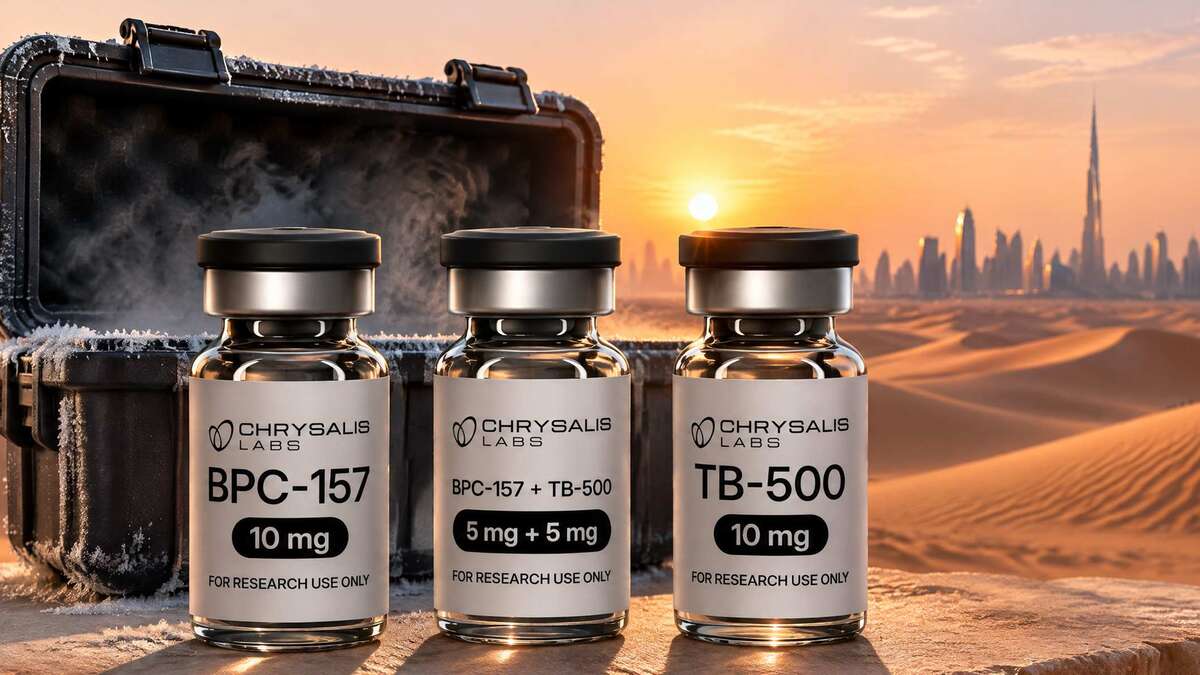
They share a vial and a plus sign, not a molecule: BPC-157 is 15 amino acids, and TB-500 is either a 7-amino-acid fragment or the full thymosin beta-4. Here is how they compare, and what “5 mg + 5 mg” really counts.
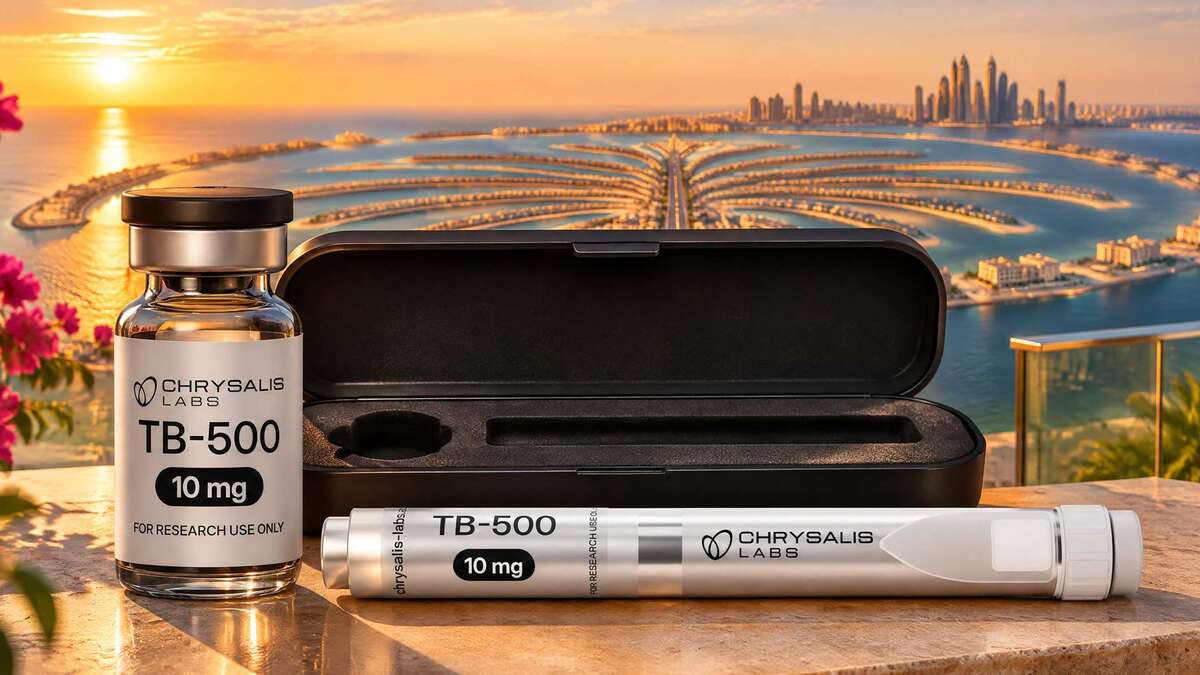
Catalogues often use the two names as one. The molecules behind them differ by 36 amino acids and more than 4,000 g/mol.