

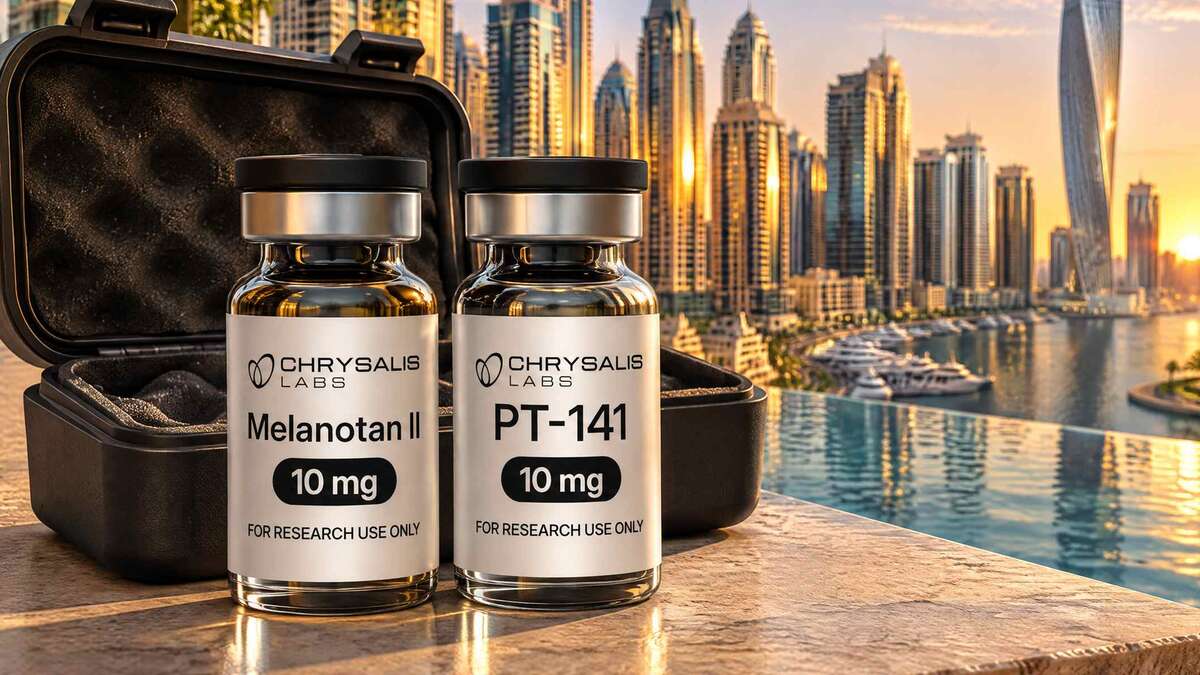
Melanotan II vs PT-141: one ring, two ends
Two lab-made peptides with the same seven amino acids and the same ring. One small group of atoms at the tail end sets them apart.
Everything on this site is supplied strictly for in-vitro laboratory research. Not for human or veterinary use.
See our Research Use Only policy (opens in a new tab)For research use only


Research areas
Strictly for in-vitro laboratory research. Not for human or veterinary use.
The short answer
Semax and Selank are two short, lab-made peptides, each a chain of seven amino acids. They start with different natural pieces but end in the same three, Pro-Gly-Pro. Semax was first made in Moscow, and Selank follows the same plan.
Semax and Selank are both peptides, short chains of amino acids, and each has exactly seven amino acids. That makes them heptapeptides, from the Greek "hepta" for seven.
A chain is written as a row of letters, one per amino acid, and read from left to right, from the start of the chain to its end.10 Written that way, Semax is MEHFPGP and Selank is TKPRPGP.1,2
Look at the last three letters. Both chains end in P, G, P (proline, glycine, proline), and that shared tail is what the two have in common.
They differ in the first four. Semax starts with methionine, glutamic acid, histidine and phenylalanine (M, E, H, F), while Selank starts with threonine, lysine, proline and arginine (T, K, P, R).1,2
Neither chain was invented from scratch. Each copies a short piece of a natural peptide and then adds the same tail.
Semax starts from ACTH, a natural peptide 39 amino acids long.3 It keeps beads 4 to 7 of ACTH (M-E-H-F) and joins Pro-Gly-Pro to the end, which is why PubChem lists it as "ACTH (4-7), Pro-Gly-Pro".1 You will also see it called an analogue of ACTH(4-10), a seven-bead stretch of ACTH.5 Semax keeps the first four beads of that stretch and swaps the last three for Pro-Gly-Pro.
Selank starts from tuftsin, a natural peptide only four amino acids long: T-K-P-R. Tuftsin is a small piece cut from a gamma globulin, a much larger protein and a type of antibody.4 Selank keeps all four of its beads and adds Pro-Gly-Pro to the end.2
Semax was made in Moscow by scientists at the Institute of Molecular Genetics, part of the Russian Academy of Sciences, in work led by two academicians, I. P. Ashmarin and N. F. Myasoedov.5 Lab work on Semax from the institute had appeared in an international journal by 1991.6
Selank was built on the same plan, a natural piece followed by the Pro-Gly-Pro tail. In 2005 a Moscow team that included Ashmarin and Myasoedov described the two side by side as "hybrid" peptides.7
Tuftsin is described. Victor Najjar's team reports the four-bead peptide.8
Semax in print. Lab work from the Moscow institute appears in an international journal.6
Two "hybrids". Semax and Selank are described together, both ending in Pro-Gly-Pro.7
Made in labs. Built by chemistry and freeze-dried for research.
This guide sticks to that chemistry: what each chain is made of.
Pro-Gly-Pro is short for proline, glycine, proline. Both are common amino acids, though each is unusual in its own way.
Every amino acid has a side group hanging off the chain. Glycine has the smallest one possible, a single hydrogen atom, while the side group of proline curls back and joins the chain at its own nitrogen atom, closing a ring.10
The Moscow team reported that peptides containing Pro-Gly-Pro are unusually stable, and that idea shaped both designs.7 In a 1991 lab test, Semax held up better than the natural ACTH stretch it copies against several serum enzymes, the proteins that cut peptide chains apart.6
Since the tail is the same in both, it can't tell them apart. Only the first four beads can.
The table puts the structure facts in one place. The formulas and weights come from PubChem, the free public chemistry database.1,2
| Fact | Semax | Selank |
|---|---|---|
| Amino acids | 7 | 7 |
| One-letter code | MEHFPGP | TKPRPGP |
| Full sequence | Met-Glu-His-Phe-Pro-Gly-Pro | Thr-Lys-Pro-Arg-Pro-Gly-Pro |
| Natural piece it starts from | ACTH, beads 4 to 7 | Tuftsin, all four beads |
| Tail | Same in both Pro-Gly-Pro | |
| Formula | C37H51N9O10S | C33H57N11O9 |
| Molecular weight | 813.9 g/mol | 751.9 g/mol |
| Sulfur atoms | 1, in methionine | None |
| PubChem record | CID 9811102 | CID 11765600 |
Their weights are close but not the same. Semax is heavier by 62 grams per mole and holds one sulfur atom, inside its methionine bead. Selank holds none.1,2
Two powders can look alike while their molecules weigh different amounts, and section 6 shows how a lab uses that.
Research Semax and Selank are made by chemistry. Like most peptides today, they are built by solid-phase synthesis, in which the chain grows one amino acid at a time, in a set order, while anchored to tiny resin beads.9 For these two, that means seven amino acids added one after another.
The finished peptide is then freeze-dried, also called lyophilised. The solution is frozen and the ice is drawn off as vapour under a vacuum, so what stays behind is a dry, light "cake" at the bottom of the vial. Our GHK-Cu guide walks through each freeze-drying step in an animation.
Unlike GHK-Cu, neither holds a metal ion, so there's no tell-tale colour to look for.
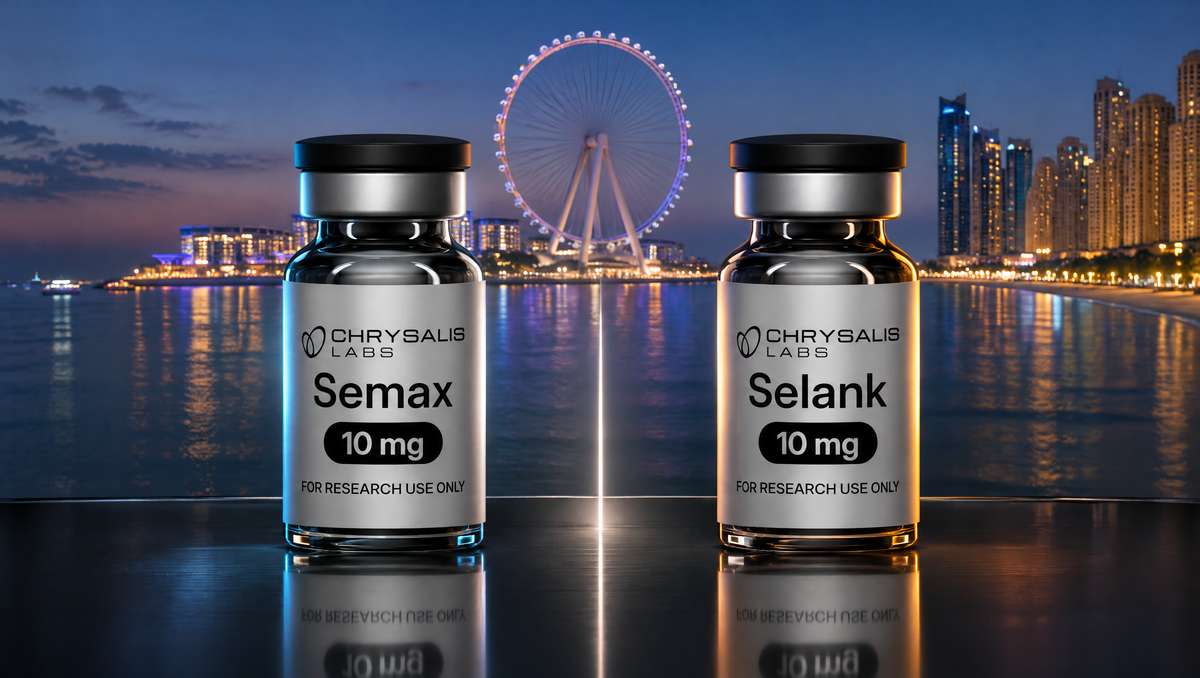
Freeze-dried powder in sealed glass. 10 mg per vial, for both Semax and Selank.
Semax vial Selank vialSupplied as a solution in a sealed pen. 10 mg per pen, for each of the two. Pens go in the fridge on arrival.
Semax pen Selank penThe 10 mg on each label is how much compound is in that one unit.
A certificate of analysis, or COA, is the lab report for one batch. With two look-alike chains like these, four questions matter most.
1Look
Appearance. Does the powder or cake match what the certificate describes?
2Weigh
Identity, by mass spec. Semax should show up near 814 and Selank near 752, so a mix-up shows at once.
3Separate
Purity, by HPLC. The sample is split into its parts, and small extra peaks are other things, such as a chain with a bead missing.9
4Measure
Content. How many milligrams are really in the vial, against the 10 mg on the label?
Purity and identity are two separate questions. A sample can be 99% one thing and still be the wrong one of the pair, because a purity figure alone can't say which chain is in the vial. An identity test such as mass spec settles that.
Purity and identity: two different questions · How to read a certificate of analysis
Heat, light and moisture can all slowly damage a peptide, and these two are no exception. The rule of thumb is to keep it sealed, cool, dry and dark.
Our storage guidance fits in three lines. Freeze-dried peptides are stable at room temperature for short periods. For long-term storage, keep sealed vials at −20 °C, away from light. Pens are kept at 2–8 °C.
In the UAE, the main heat risk is the time a parcel spends on the road. In Dubai and Sharjah, orders placed before 14:00 on a working day usually arrive the next working day.
Strictly for in-vitro laboratory research. Not for human or veterinary use.
Their first four amino acids. Semax starts with M-E-H-F, taken from ACTH, and Selank starts with T-K-P-R, which is tuftsin. Both end in the same three, Pro-Gly-Pro.
Semax was made in Moscow, at the Institute of Molecular Genetics of the Russian Academy of Sciences, and Selank follows the same design. In 2005 a Moscow team that included the two academicians behind Semax described the two peptides together.
Proline, glycine, proline. These three amino acids form the last part of both chains, written PGP in one-letter code.
Semax is 813.9 g/mol (C37H51N9O10S). Selank is 751.9 g/mol (C33H57N11O9). Both figures are from PubChem.
The vial holds freeze-dried powder in sealed glass, while the pen holds the compound as a solution and is kept in the fridge. Both hold 10 mg, for Semax and for Selank.
Yes, to all seven emirates. In Dubai and Sharjah, orders placed before 14:00 on a working day usually arrive the next working day.
Vials and pens, 10 mg each, delivered across all seven emirates. Cash on delivery available.
Strictly for in-vitro laboratory research. Not for human or veterinary use.
Chrysalis Labs Research Team · Published
Two lab-made peptides with the same seven amino acids and the same ring. One small group of atoms at the tail end sets them apart.
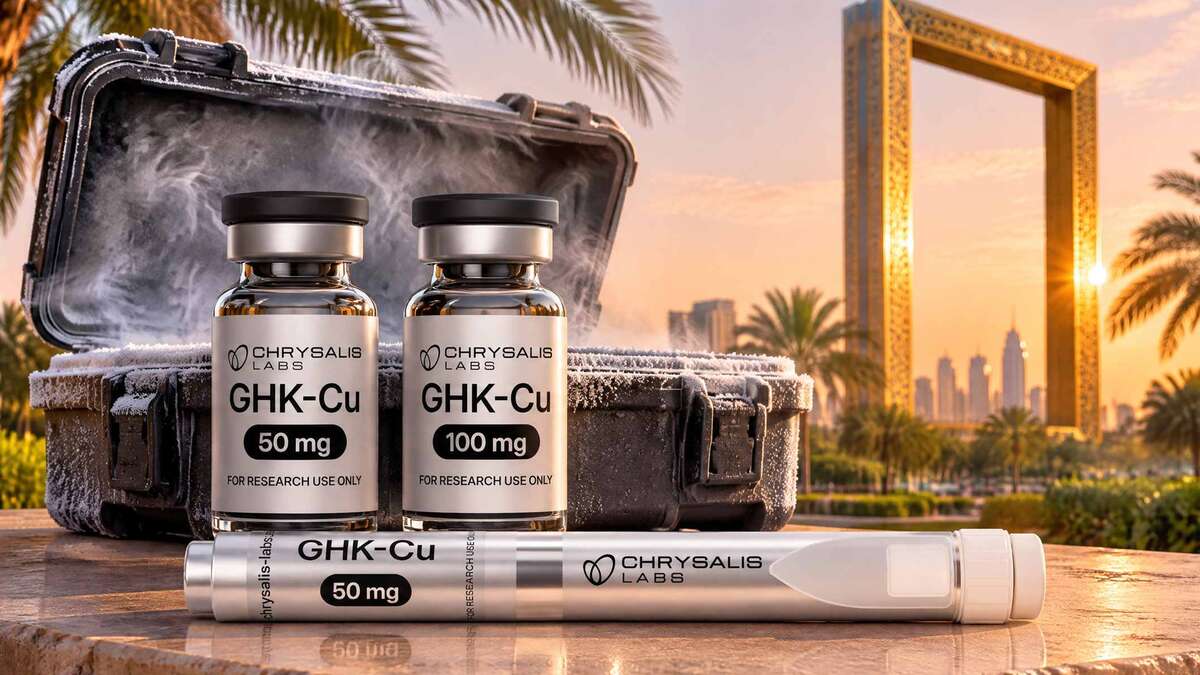
Up to about 16 mg of every 100 mg on a GHK-Cu label is copper, not peptide. What the number holds, and how to put a 50 mg and a 100 mg unit on one price scale.
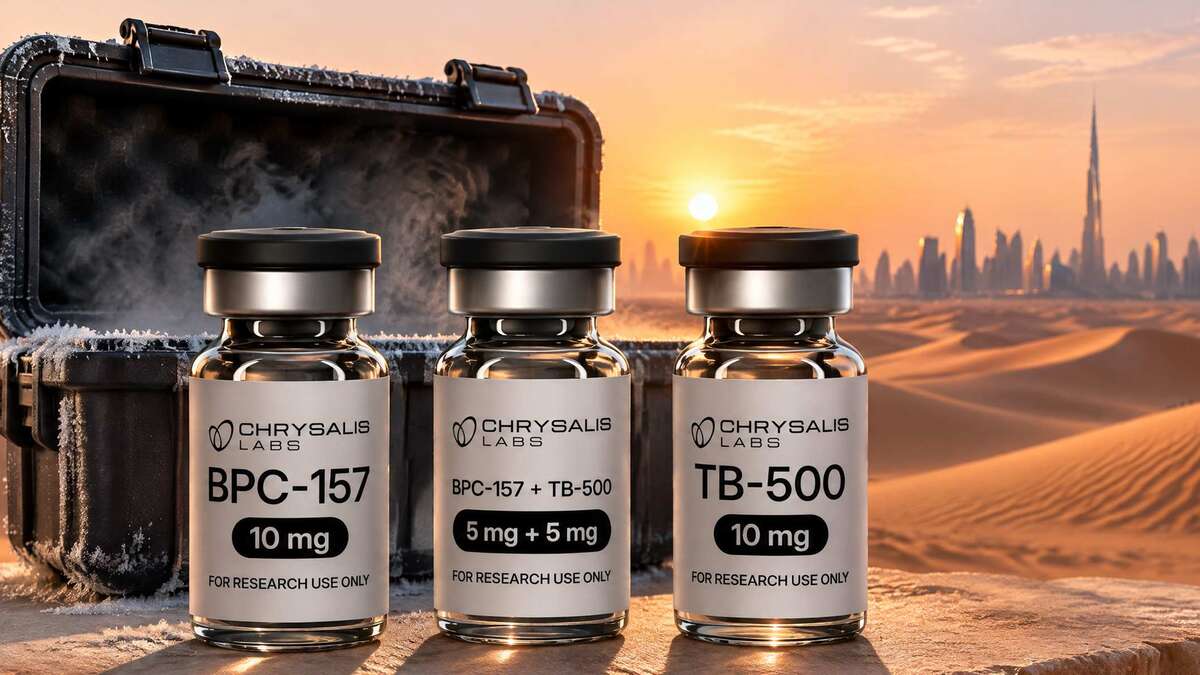
They share a vial and a plus sign, not a molecule: BPC-157 is 15 amino acids, and TB-500 is either a 7-amino-acid fragment or the full thymosin beta-4. Here is how they compare, and what “5 mg + 5 mg” really counts.